Converging AI Culture War Controversies: How AI Shock Campaigns Illuminate Affective Capitalism’s Absorption of Critique Into Spectacle
Article Sidebar
Main Article Content
Abstract
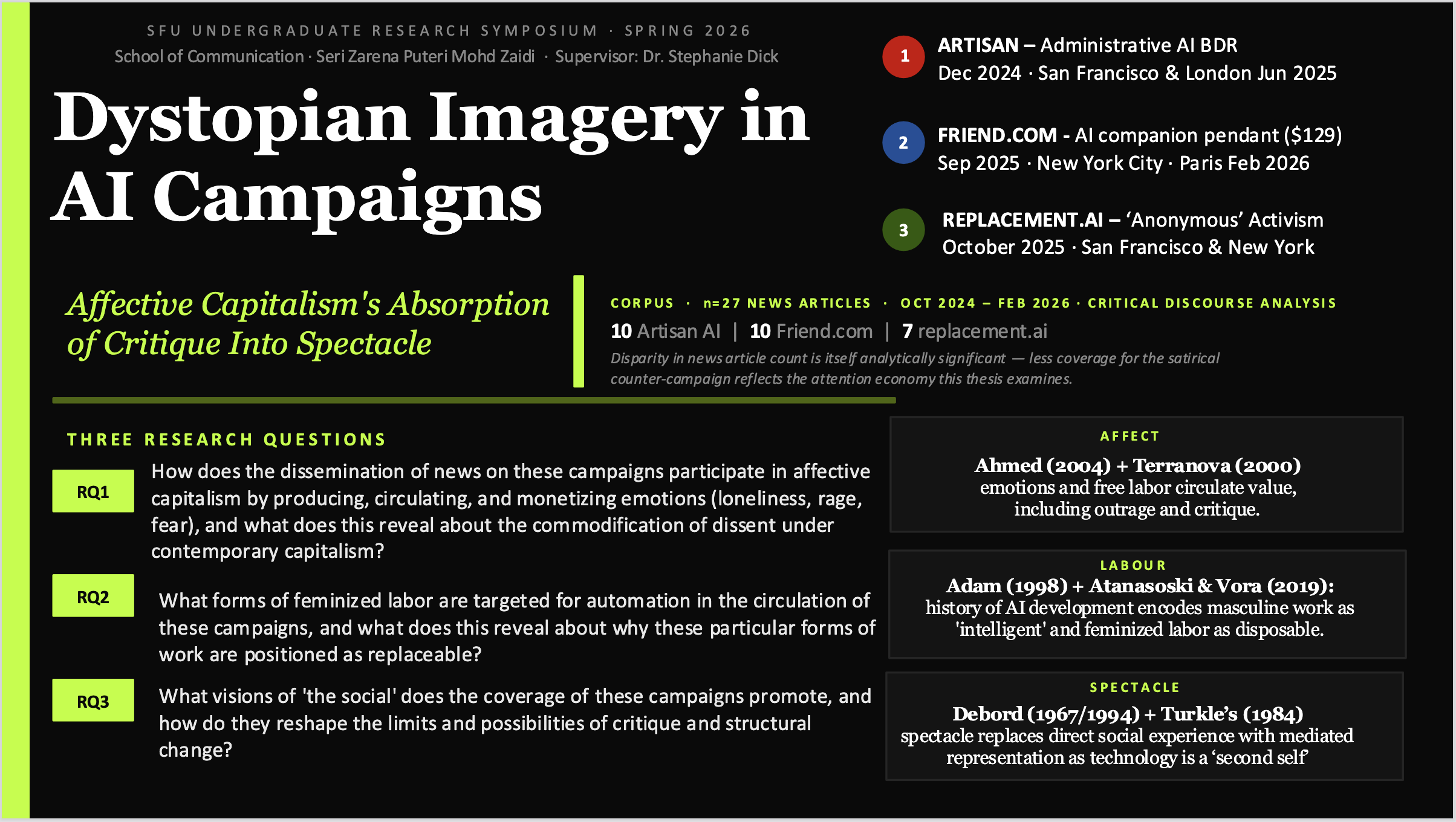
Between December 2024 and October 2025, three AI campaigns generated viral controversy across major cities. Artisan AI launched billboards declaring "Stop Hirring Humans," with their CEO openly describing this as "rage bait" designed to generate attention through outrage. Friend.AI deployed a New York subway campaign displaying the dictionary definition of friendship alongside their AI companion device, provoking citywide graffiti vandalism. An ‘anonymous’ activist collective launched replacement.ai with satirical billboards featuring dystopian AI products, though many viewers could not distinguish the parody from genuine corporate advertising. Through qualitative discourse analysis of campaign materials, corporate statements, and public responses across social media, news coverage, and physical interventions, this research investigates what these controversies reveal about how communication systems have been restructured under contemporary capitalism.
Drawing on affective capitalism, feminist technology studies, and spectacle theory, this study is guided by three interconnected research questions: how these campaigns monetize emotions including dissent by transforming existential fears into circulating content; what patterns in the targeting of feminized labor reveal about gendered hierarchies of replaceability; and what these dynamics expose about capitalism's capacity to absorb critique into spectacle. Early findings demonstrate that these campaigns make visible what usually remains implicit under neoliberal capitalism: that humans are increasingly positioned as replaceable and that resistance itself becomes commodified. When corporate executives celebrate engineering controversy and activist responses become indistinguishable from actual advertising, the result illuminates a fundamental shift in how communication operates, raising urgent questions about the possibilities for meaningful opposition and lasting structural change.
Article Details

This work is licensed under a Creative Commons Attribution-NonCommercial-NoDerivatives 4.0 International License.