
Finding Tomorrow's Floods Today: Climate Risk Analogues
Article Sidebar
Main Article Content
Abstract
Climate analogues are commonly used in climate adaptation to help cities understand what future climate conditions might feel like by comparing them to places that already experience similar conditions today. However, these comparisons are typically based on climate variables alone and rarely incorporate measures of climate risk.
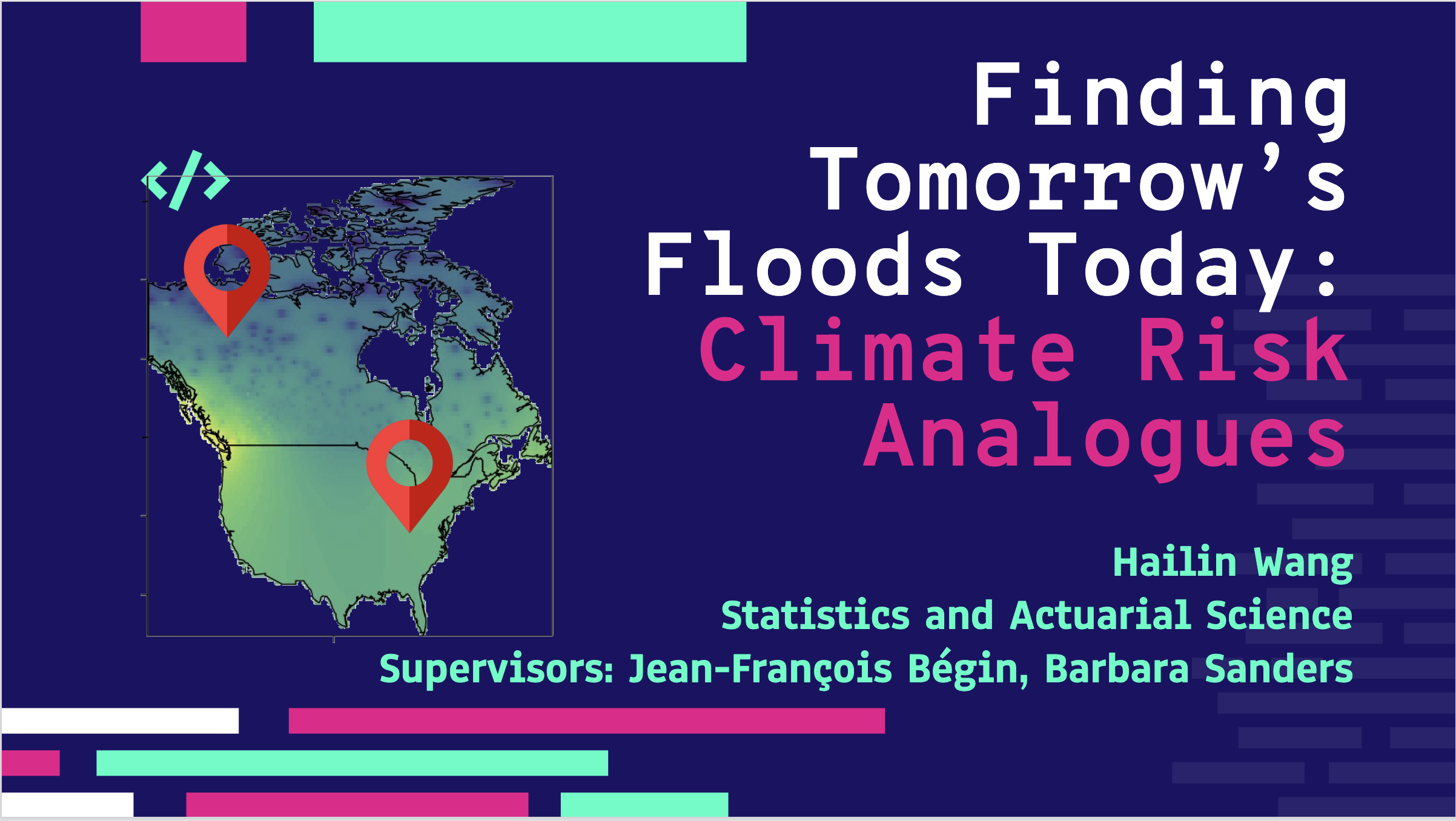
This study extends the concept of climate analogues by integrating flood risk. Focusing on North America, we estimate present-day and future flood risks for the year 2050 under two climate change scenarios that reflect action or inaction against rising greenhouse gas emissions. Flood risk is defined by multiple outcomes, including the probability of flooding, flood severity, and associated human impacts such as deaths and displacement. A combination of machine learning models is used to generate these risk estimates.
Using these predictions, we identify flood risk analogues: locations today that exhibit similar flood risk profiles to a target city’s projected risk in 2050. While limitations in data resolution, interpolation methods, and model performance present challenges to this exploration, the results highlight both the challenges and the potential of this approach. With improved data quality and model refinement, flood risk analogues could offer a powerful tool for communicating climate risk and supporting adaptation planning across policy, urban planning, and insurance contexts. This study will be presented in the format of an Ignite talk, emphasizing high-level contexts and clear visuals.
Article Details

This work is licensed under a Creative Commons Attribution-NonCommercial-NoDerivatives 4.0 International License.