
Designing for Livability: Special District Design Guidelines for the Vancouver Villages Planning Program
Article Sidebar
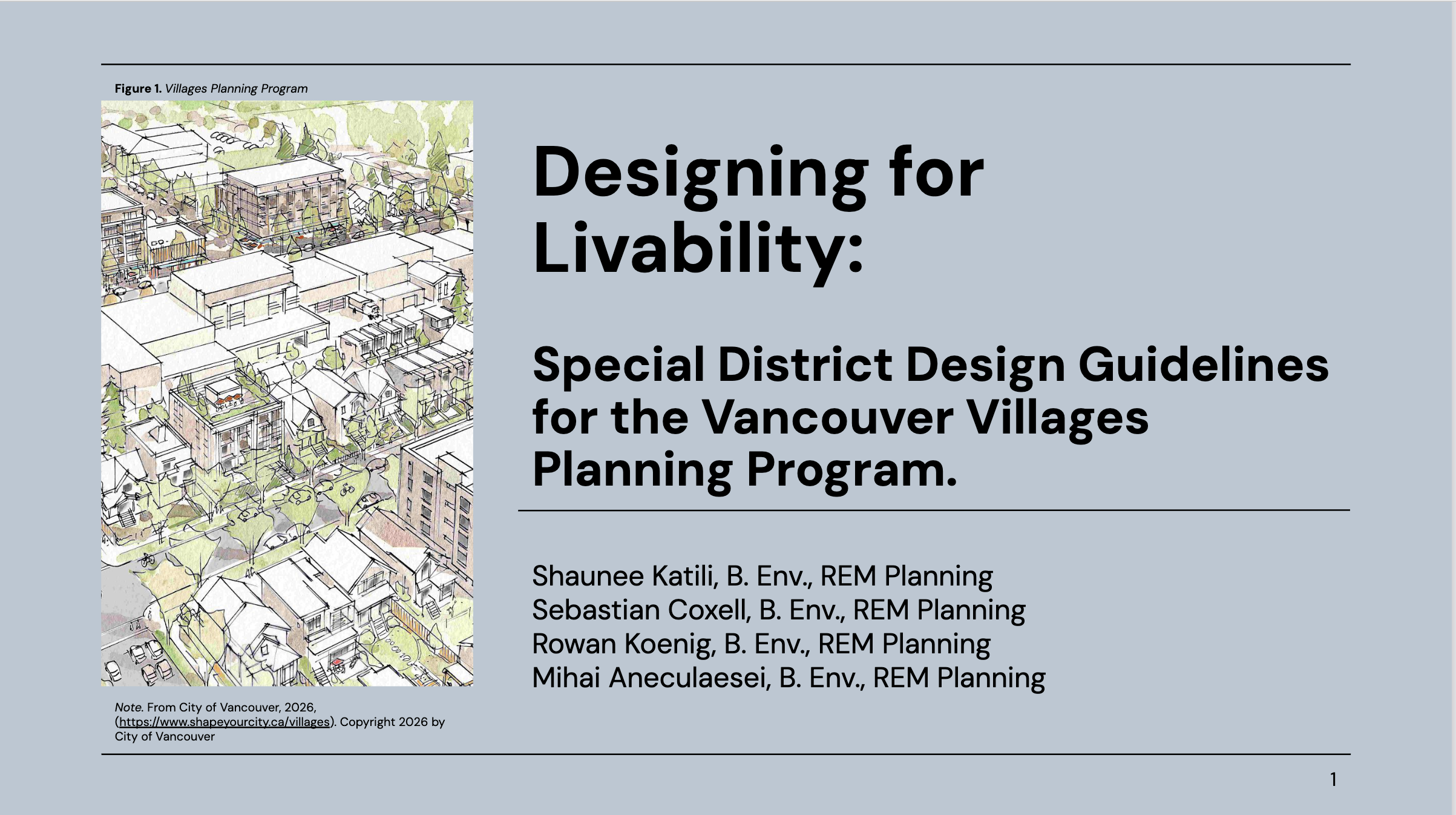
Main Article Content
Abstract
As Vancouver advances the Vancouver Villages Plan (VVP), the introduction of Missing Middle housing represents a critical intervention within predominantly low-density neighbourhoods. Yet the extent to which medium-density intensification can enhance affordability while fostering social cohesion remains conceptually and institutionally unresolved. This study operationalizes “housing livability” across social, economic, and ecological dimensions and evaluates how design regulation functions as a governance instrument in shaping these outcomes.
The research begins with a systematic review of academic literature, municipal planning documents, and regional housing analyses to establish a working definition of livability and identify measurable design attributes. Public perception data are then collected through Likert-scale surveys administered within selected village sites to assess baseline evaluations of neighbourhood livability. Survey findings inform the development of proposed Vancouver Villages Special District Design Guidelines tailored specifically to Missing Middle housing contexts.
To assess feasibility and institutional alignment, semi-structured interviews are conducted with municipal planners, non-profit housing providers, and private-sector developers. Interview data are thematically analyzed to identify regulatory, financial, and organizational constraints affecting implementation. A comparative policy analysis subsequently evaluates the relative capacity of existing city-wide design guidelines and the proposed Special District framework to enable livability according to the established criteria.
Ultimately, this research reframes design guidelines not as passive compliance tools, but as deliberate governance mechanisms capable of reshaping the social and spatial conditions of urban life.
Article Details

This work is licensed under a Creative Commons Attribution-NonCommercial-NoDerivatives 4.0 International License.