
DC Microgrid Feasibility for a Remote Community
Article Sidebar
Main Article Content
Abstract
Remote communities often depend on unstable or insufficient electricity infrastructure for day-to-day life. This exposes community members to high costs, frequent outages, and reduced capacity for growth. Our student research team, VerdeNova, designed a resilient, low carbon microgrid system representative of a remote community in central BC. Our design prioritizes reliability, affordability, and community stewardship of land.
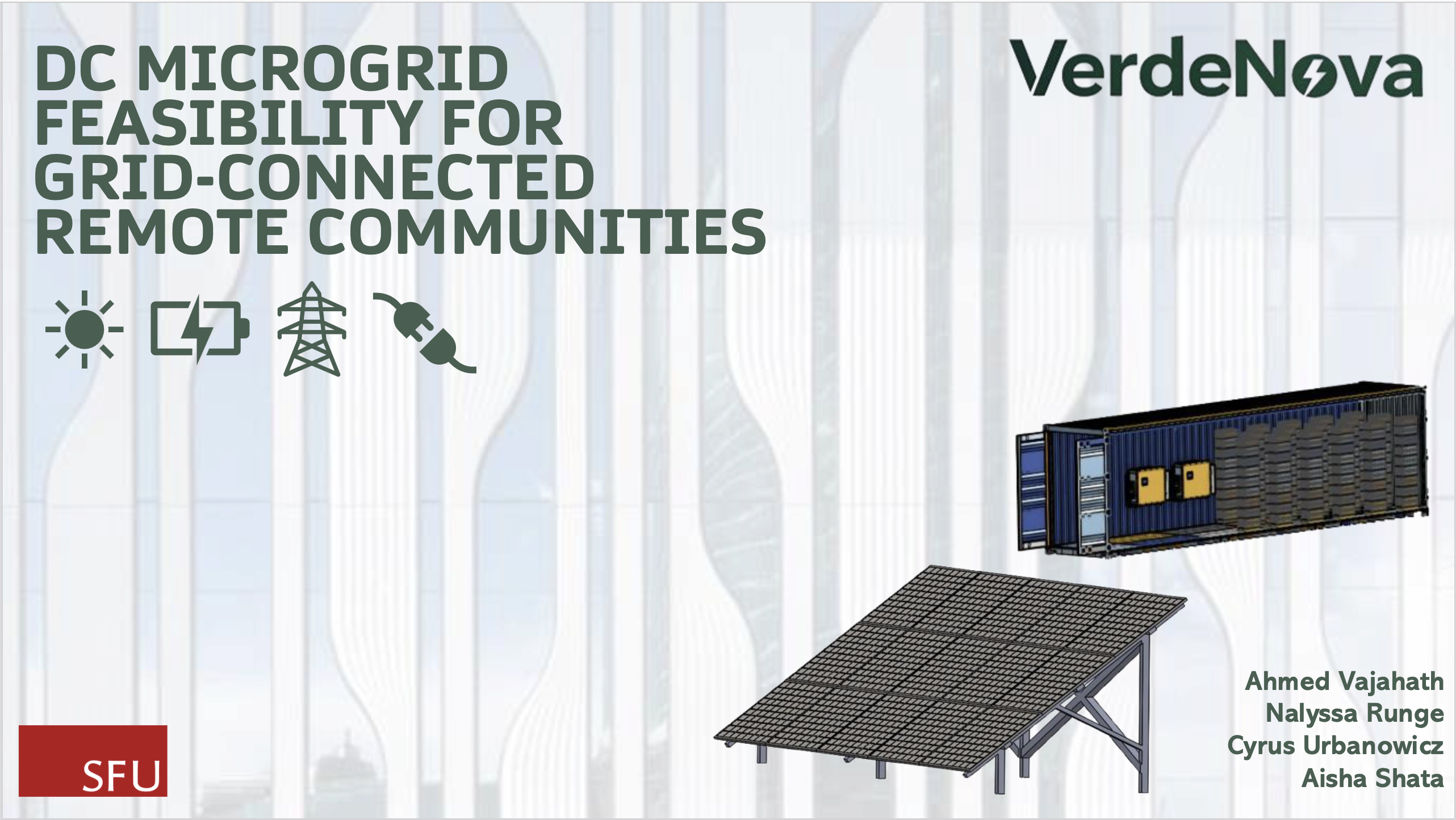
The proposed system combines solar photovoltaics (PV), a lithium-ion-phosphate (LFP) battery energy storage system, and a backup diesel generator. We used a structured decision process to select major components, such as load profiling, resource assessment, objective tree weighting, and decision matrices. We then evaluated safety and operability with a failure modes and effects analysis (FMEA) and life cycle emissions compared against a diesel only system of scale. Preliminary results indicate that a PV and battery system can cut operational emissions by an order of magnitude while maintaining reliability during extreme weather events. The backup generator would cover rare extended low sun periods and wildfire smoke events. Cost modelling suggests competitive levelized costs and a realistic pathway to payback when diesel prices and fuel transportation are considered. The software focus utilized PVSyst.
Our presentation will share (1) the criteria driven approach we used to balance ethics, economics, and the environment; (2) the technical concept and controls; and (3) impacts for residents, reducing emissions, improved energy security, and skills pathways for local operations. We conclude with our next steps: refining modelling, vendor engagement, and field ready implementation co-developed with the community and client.
Article Details

This work is licensed under a Creative Commons Attribution-NonCommercial-NoDerivatives 4.0 International License.