
Activity and Inhibition of 6S RNA: A Regulatory Bacterial RNA
Article Sidebar
Main Article Content
Abstract
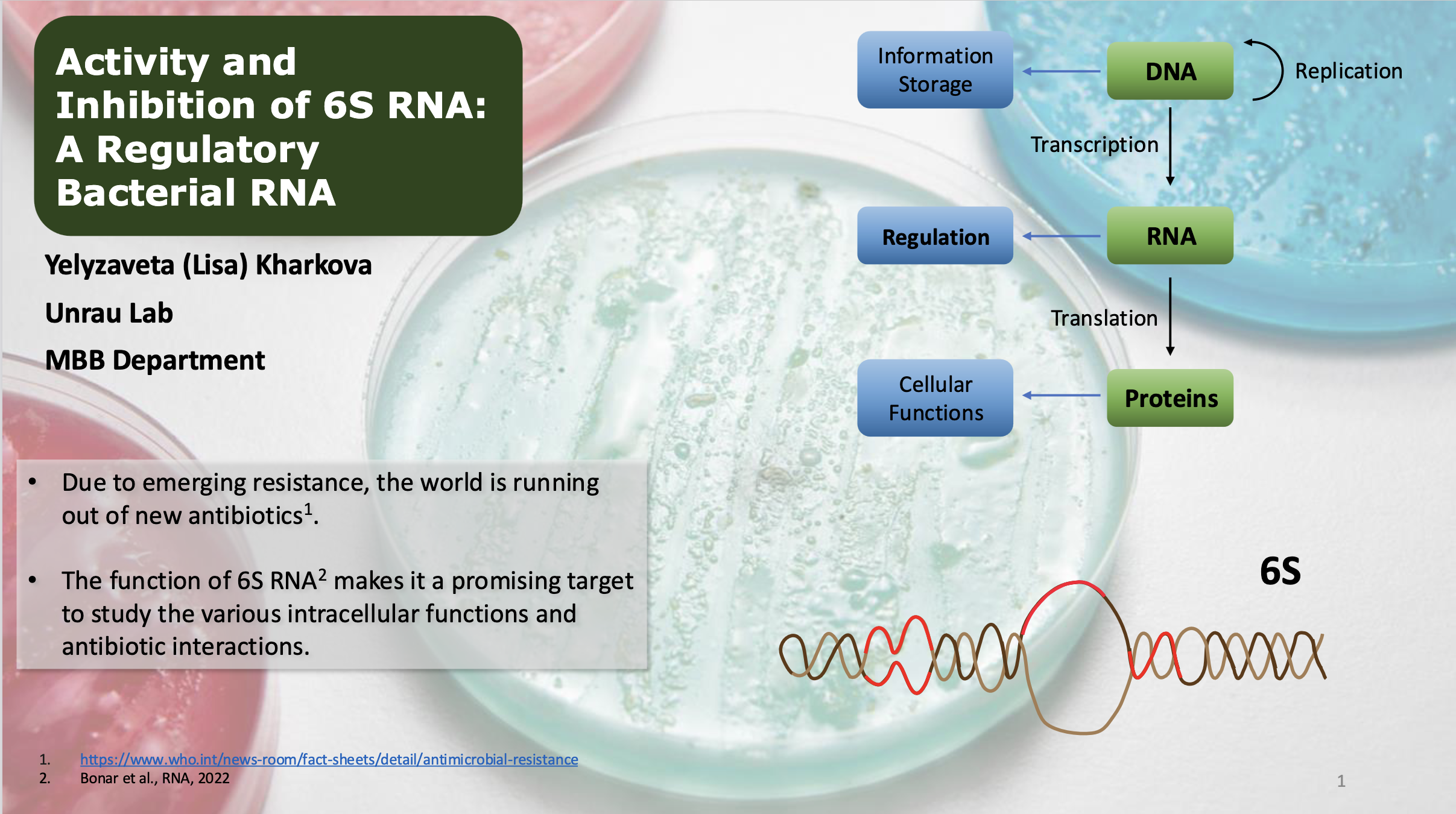
Since their discovery in the 20th century, antibiotics have remained the most widely used treatment for bacterial infections. However, their usage leads to an increasing amount of resistant bacteria. For example, bacteria can rapidly develop resistance against Rifampicin, an antibiotic that blocks mRNA production by RNA polymerase (RNAP). One way to address this problem is to focus on other substrates that can bind to RNAP and inhibit its function. 6S RNA can bind to RNAP and serve as a template for short product RNA (pRNA) synthesis. It blocks the RNAP until pRNA is fully synthesized, and it is then released. We hypothesize that Rifampicin obstructs the elongation of pRNA (thus slowing down 6S release) in the same way it obstructs transcription of mRNA. Our in vitro studies indicate that Rifampicin decreases both the release rate and total amount of released 6S RNA in both wild type (WT) and partially release-defective (SR) 6S RNA. SR mutants may be synergistic with Rifampicin inhibition, enhancing transcriptional inhibition. If such synergies are observed, release defective 6S mutants could serve as a proxy for small molecules able to inhibit 6S RNA release and act in combination with Rifampicin to increase RNAP inhibition effectiveness. Additionally, we suspect that the 6S may be associated with bacterial response to oxidative stress, which is used by our immune system to clear infections. We found that increasing amounts of hydrogen peroxide (which causes oxidative stress) delay the beginning of the exponential growth phase in SR bacteria compared to WT.
Article Details

This work is licensed under a Creative Commons Attribution-NonCommercial-NoDerivatives 4.0 International License.