
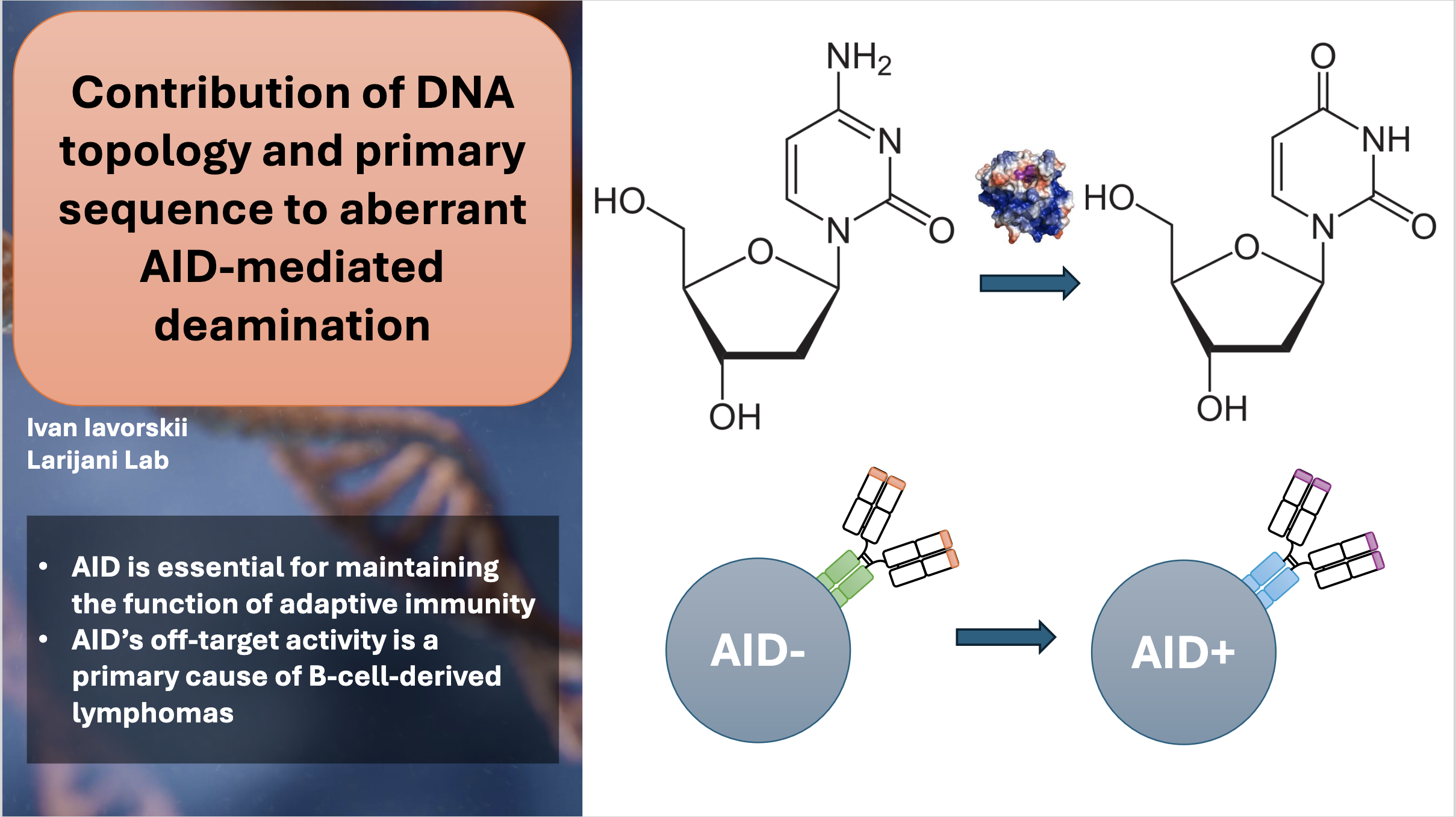
Contribution of DNA topology and primary sequence to aberrant AID-mediated deamination
Article Sidebar
Main Article Content
Abstract
Activation-induced cytidine deaminase (AID) is an essential enzyme for producing antibody diversity, but its genome-wide off-target activity is a major contributor to B-cell lymphoma development. Building on previous work, this study addresses AID’s promiscuous activity from the standpoint of DNA nucleotide sequence and three-dimensional DNA winding state (topology). Using the Mutation Pattern Browsers for GAMBL (Mutational Map of B-Cell Lymphomas), 1.3*103-nucleotide-long regions with the highest and lowest mutational density within AID hotspots (peaks & valleys) were selected from genes subjected to AID off-target mutagenesis. Alongside, control fragments were derived from genes that are protected from AID’s activity. These sequences were processed to achieve a desired topology and utilized for AID mutagenesis assays, data from which were collected by PCR amplification and next-generation sequencing (NGS). Preliminary assays of three peaks (derived from genes: IGLL5, BCL6, MYC) and a control (derived from genes: PRKCB) showed an order of magnitude higher AID-induced mutation frequencies in peaks. Additionally, differences in mutational density among peak fragments derived from GAMBL mirrored these assays’ observations. Complementary to these results, peak regions showed clustering of C→T/G→A nucleotide substitutions, an AID mutational footprint. These data hint that DNA sequence-encoded properties contribute to the heightened AID activity across peak regions. In the continuation of this project, I intend to extend the experimental framework by incorporating more peak, valley and control fragments across different DNA topologies under various external conditions affecting DNA helix stability. I will then present a comparative analysis of mutational frequencies and footprint profiles alongside sequence-specific topology simulations.
Article Details

This work is licensed under a Creative Commons Attribution-NonCommercial-NoDerivatives 4.0 International License.