
Tracking the Decline of Starburst Activity in Post-Merger Galaxies
Article Sidebar
Main Article Content
Abstract
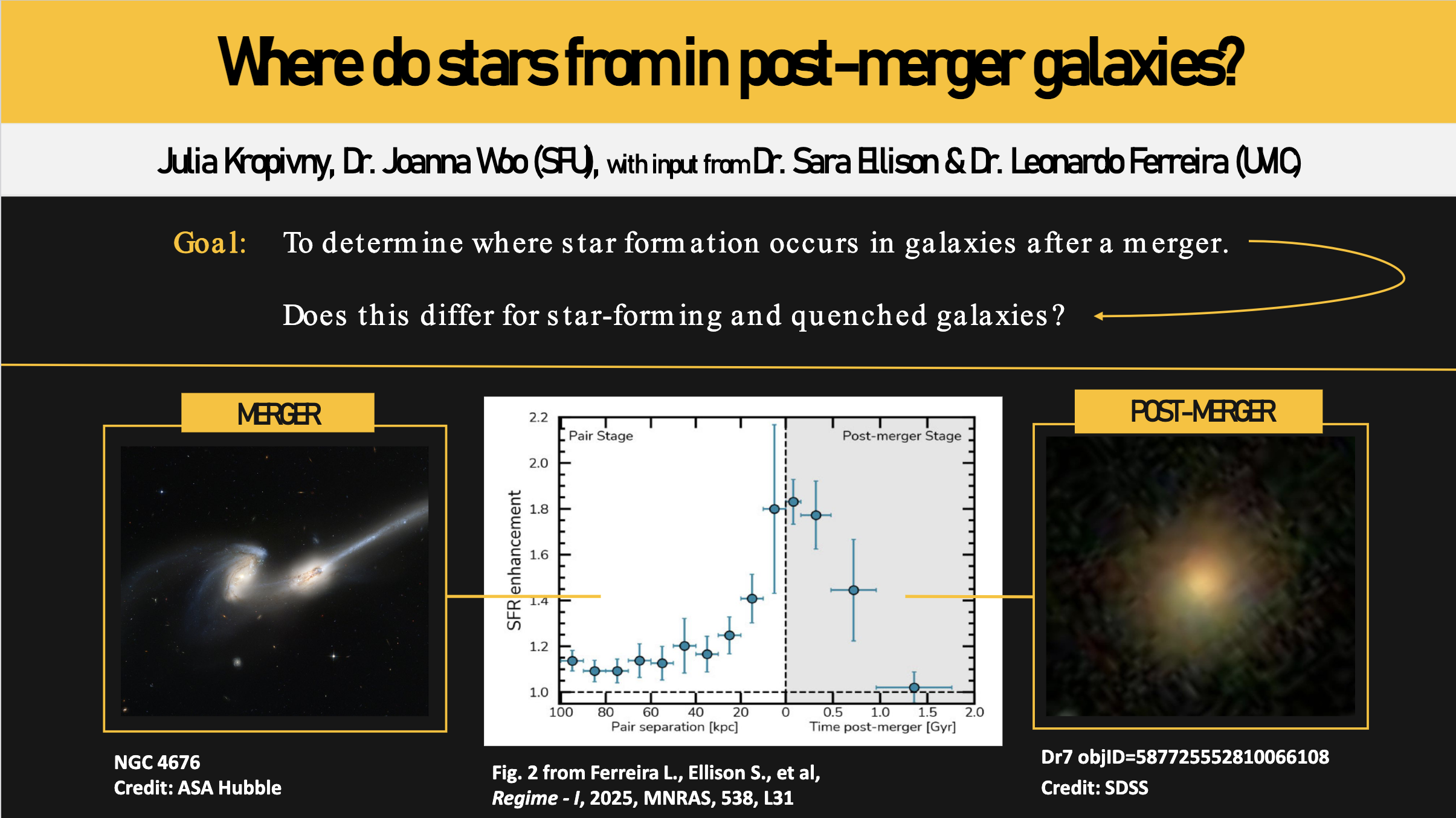
When galaxies merge their star formation rate can increase dramatically, triggering a starburst whose effects last up to ∼1 Gyr after coalescence. At the same time, the number of post-merger galaxies that shut down star formation is 30–60 times higher than non-merger galaxies of similar mass. This raises two key questions: where within galaxies does the initial starburst occur, and where does star formation begin to subsequently quench?
Using circular aperture photometry for 1186 post-merger galaxies from the Sloan Digital Sky Survey with log(M*)>9.5 at 0.08 < z < 0.15, I have found that post-merger galaxies have relatively more young stars at their centers compared to a matched non-merger control sample. This excess fades within 1 Gyr of coalescence. However, it seems only actively star-forming galaxies return to their pre-merger distribution of young stars; quenched galaxies, which aren't able to replenish young stars at their edges, retain younger stellar populations concentrated toward their centers.
Article Details

This work is licensed under a Creative Commons Attribution-NonCommercial-NoDerivatives 4.0 International License.