
Multi-Illumination Photography
Article Sidebar
Main Article Content
Abstract
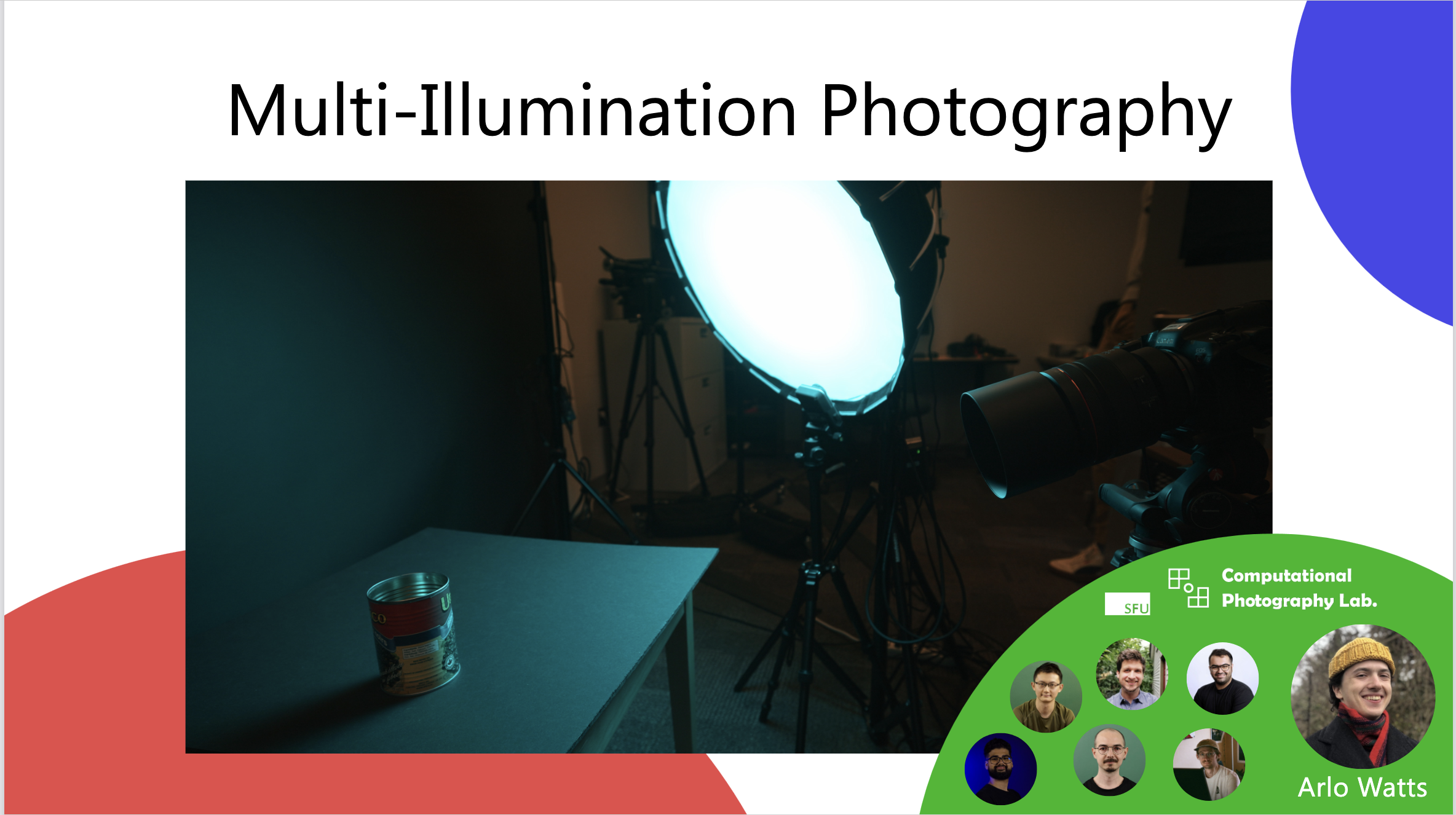
I will present the details of our photography studio setup, which we use to capture multi-illumination image sets. I will also share some examples and applications for hyperspectral photography.
There are four main components to our image capture pipeline: cameras, lights, a spectrometer, and a custom software-based controller.
We use up to eight Canon R5C cameras to capture a scene in our studio from multiple angles. The cameras are configured to capture each image with a range of exposures, which we later use to reconstruct a high dynamic range (HDR) image.
We have four spotlights with six LEDs each, enabling us to control the scene illumination across the entire visible light spectrum. Each of the six LEDs is a different colour: red, green, blue, amber, cyan, and lime. Combining them with varying brightnesses can produce light with a wide variety of spectra.
Our spectrometer measures the exact light spectrum of one light at a time. If we know the exact light spectrum, then a digital image can tell us how the surfaces in the scene reflected that light into the camera’s sensor. This kind of reflectance information can be used to reconstruct material properties in the scene.
Finally, our software-based controller coordinates all of these devices automatically. To capture a multi-illumination image set, it sets the light colour; measures the light spectrum with the spectrometer; takes a picture with the cameras; and repeats. By the end of the process, we have a complete set of high-quality multi-illumination HDR images.
Article Details

This work is licensed under a Creative Commons Attribution-NonCommercial-NoDerivatives 4.0 International License.