Spirit and Skill: How personality, team roles, and team culture shape skill in Ultimate Frisbee
Article Sidebar
Main Article Content
Abstract
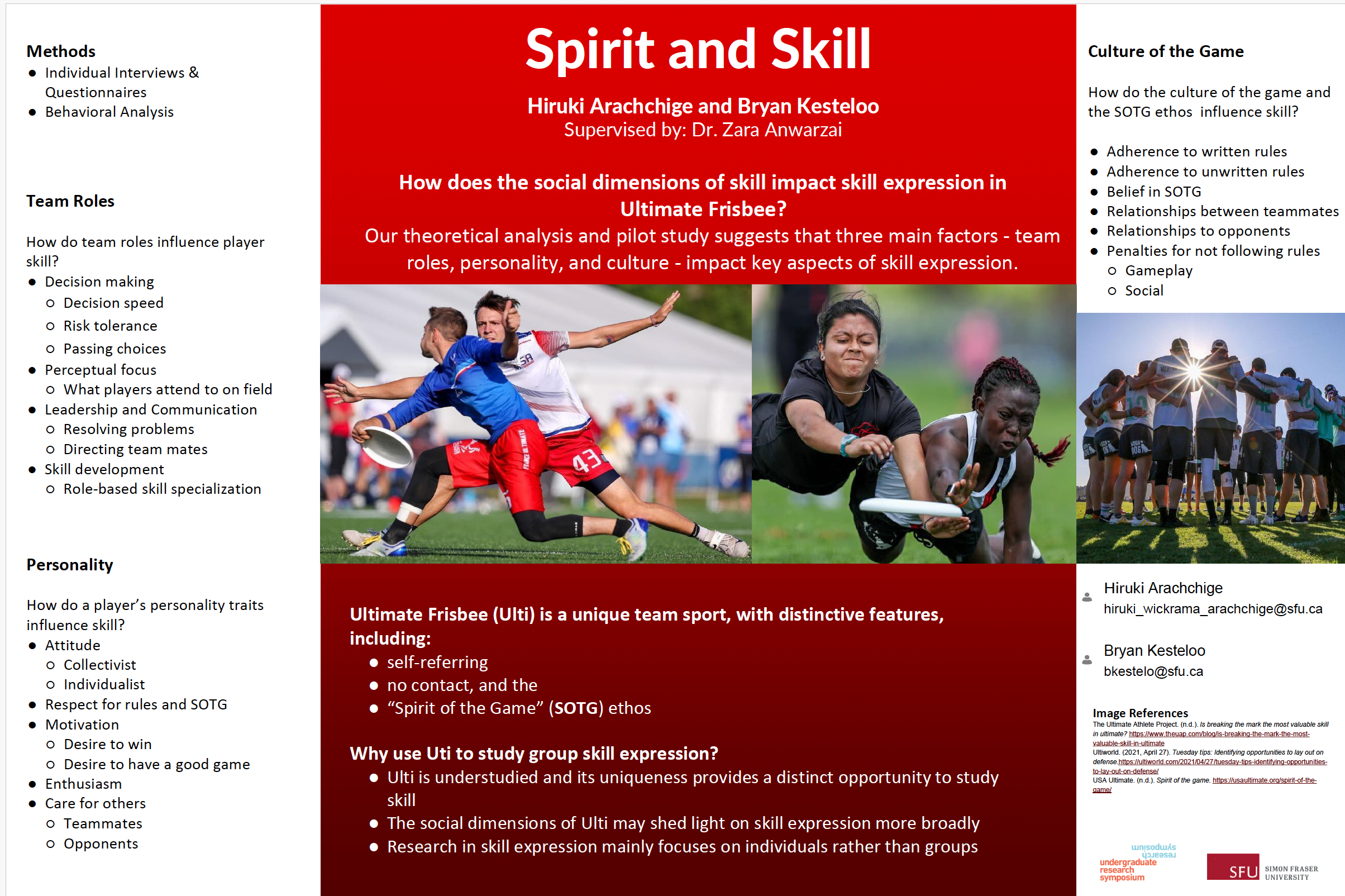
Ultimate Frisbee is an understudied sport with a unique ethos, Spirit of the Game (SOTG), which includes distinctive features such as self-referring and non-contact. SOTG is both an overarching, unspoken and mutually understood ethos, as well as a set of formal rules. The relationship between the culture of gameplay and the cognitive science of skill is also understudied. Our research is an empirically informed qualitative study which breaks ground on these under-explored areas to shed light on different social dimensions of individual skill expression.
We study how three factors (culture of the game, individual team roles, and individual personality traits) bear on different aspects of individual skill expression, including an individual performer’s subjective experience (e.g., their level of enthusiasm), a performer’s perceptual experience (e.g., making good predictions) and a performer’s performance on the field (e.g., passing accuracy).
At the current stage, our research consists of pilot interviews and theoretical critique of the current empirical literature. Our broader study design includes player interviews, questionnaires and gameplay analysis focusing on individual player behaviour and group dynamics. Our preliminary research suggests that culture of the game and individual team roles both play an outsized role in determining certain aspects of individual skill expression. For example, SOTG bears on a player’s decision making during gameplay, and individual roles (e.g., as captain or mentor) bears on the ability to make good predictions.
Article Details

This work is licensed under a Creative Commons Attribution-NonCommercial-NoDerivatives 4.0 International License.