Beyond Suppression: How Social-Evaluative Stress Drives Testosterone Reactivity
Article Sidebar
Main Article Content
Abstract
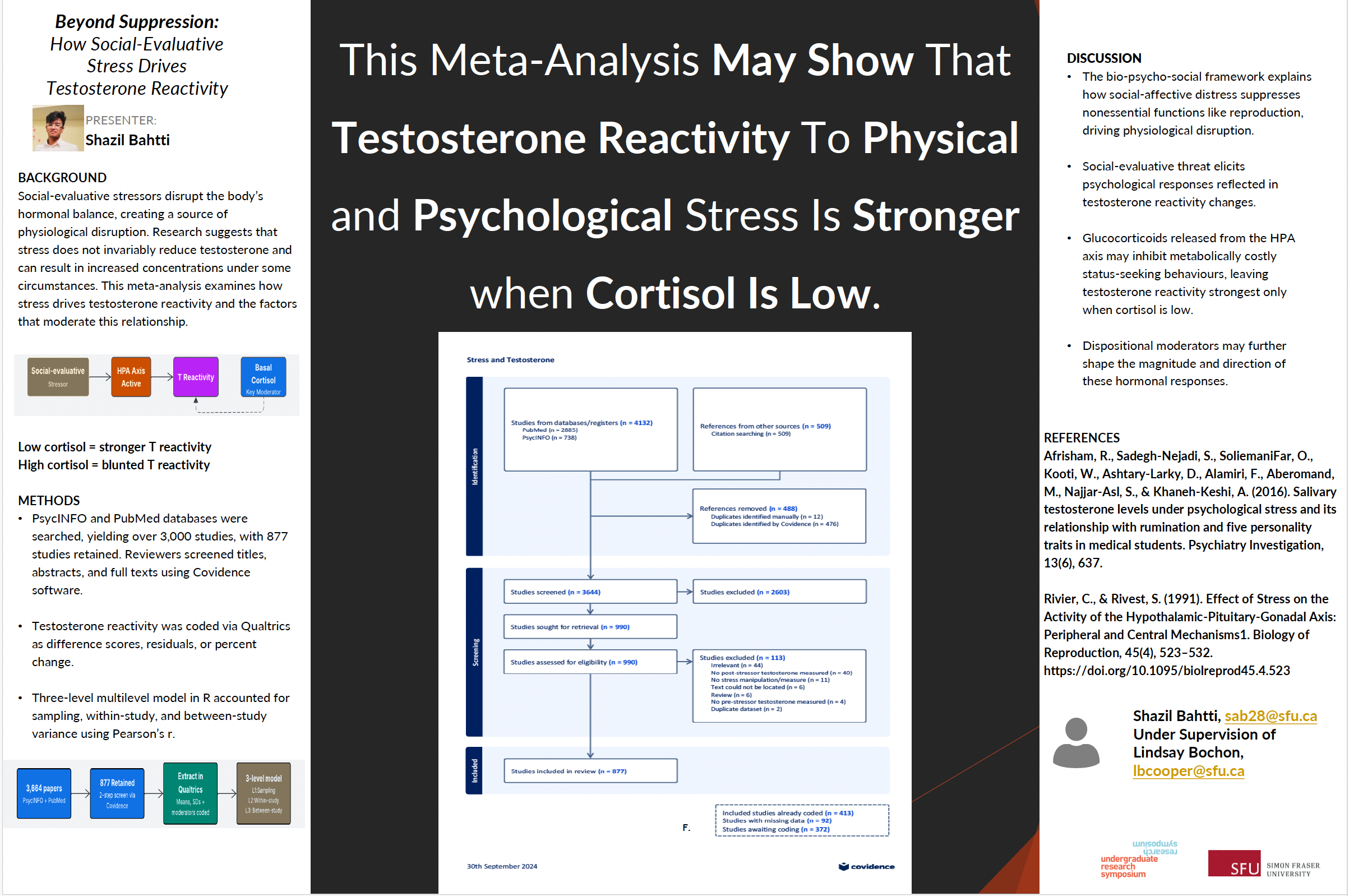
Social-evaluative stressors, encompassing exclusion and neglect, represent more than a minor emotional setback; for many individuals, they serve as a significant source of physiological disruption. In this poster presentation, I will guide the audience using a meta-analysis, a statistical technique that synthesizes data from multiple studies to identify overarching patterns.
This approach increases statistical power and yields more reliable estimates of effects than individual studies alone. Importantly, dispositional factors serve as critical moderators of these effects. In this presentation, I will focus on how stress affects testosterone concentrations by analyzing testosterone reactivity, measured as the hormonal response to social challenges, and how these factors influence this relationship.
In my poster presentation, I will guide the audience through the systematic research process, beginning with a comprehensive literature search across academic databases to identify all relevant studies. After assembling the research pool, I applied inclusion and exclusion criteria to screen articles. The most essential phase involved data extraction, during which I recorded key statistics, including mean scores, standard deviations, and sample sizes.
By adopting a bio-psycho-social framework, this presentation seeks to clarify the specific biological and personality mechanisms that transform social-affective distress into physiological disruption. Within this framework, social-evaluative threat operates as a stressor that elicits psychological responses, which are reflected in biological changes in testosterone reactivity. Dispositional moderators may further shape the magnitude and direction of these hormonal responses.
Article Details

This work is licensed under a Creative Commons Attribution-NonCommercial-NoDerivatives 4.0 International License.