
Characterization of local C. difficile clinical isolates and comparisons to regional and global isolates with WGS
Article Sidebar
Main Article Content
Abstract
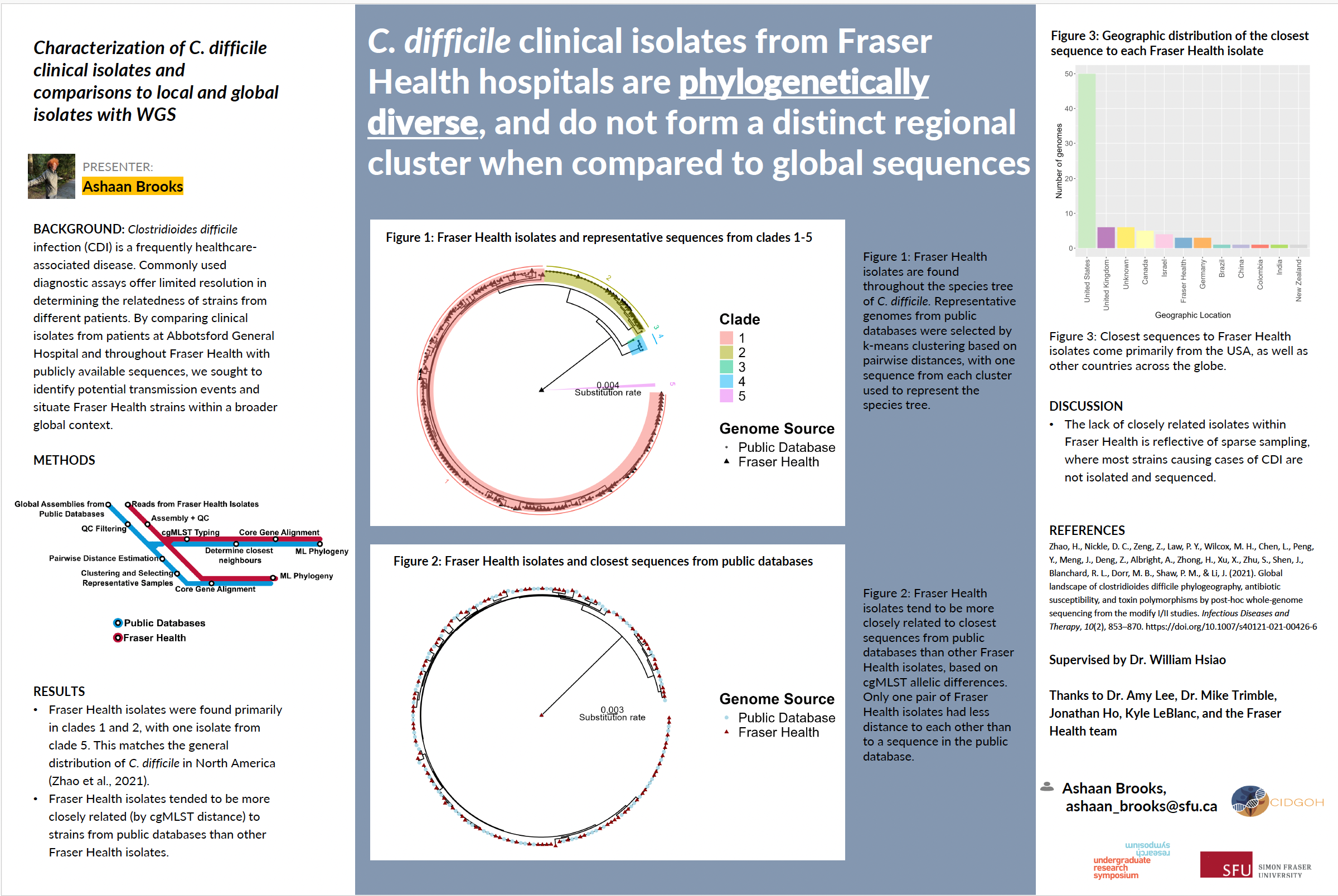
Clostridioides difficile infection (CDI) is a frequently healthcare-associated disease. However, in-hospital transmissions are often difficult to identify and track, as asymptomatic colonization of C. difficile is common. Further, commonly used diagnostic assays, such as PCR ribotyping, offer limited resolution in determining the relatedness of strains from different patients. Using whole-genome sequencing, we characterize the genomic features of clinical C. difficile isolates from CDI patients in Fraser Health. Using a variety of these genomic features, including SNP-based methods, core genome multi-locus sequence typing (cgMLST), accessory genome features, and genetic determinants of antimicrobial resistance, we compare these local clinical isolates to other isolates from around the Fraser Health region from previous years, collected by the Canadian Nosocomial Infection Surveillance Program (CNISP), as well as publicly available global strains from NCBI databases. Using molecular data, we aim to confirm potential transmission links between clinical isolates and situate our local C. difficile strains within both a regional and broader global context.
Article Details

This work is licensed under a Creative Commons Attribution-NonCommercial-NoDerivatives 4.0 International License.