
How Parents Support Children’s Autonomy: Looking at Age-Related Differences in Autonomy-Supportive Parenting
Article Sidebar
Main Article Content
Abstract
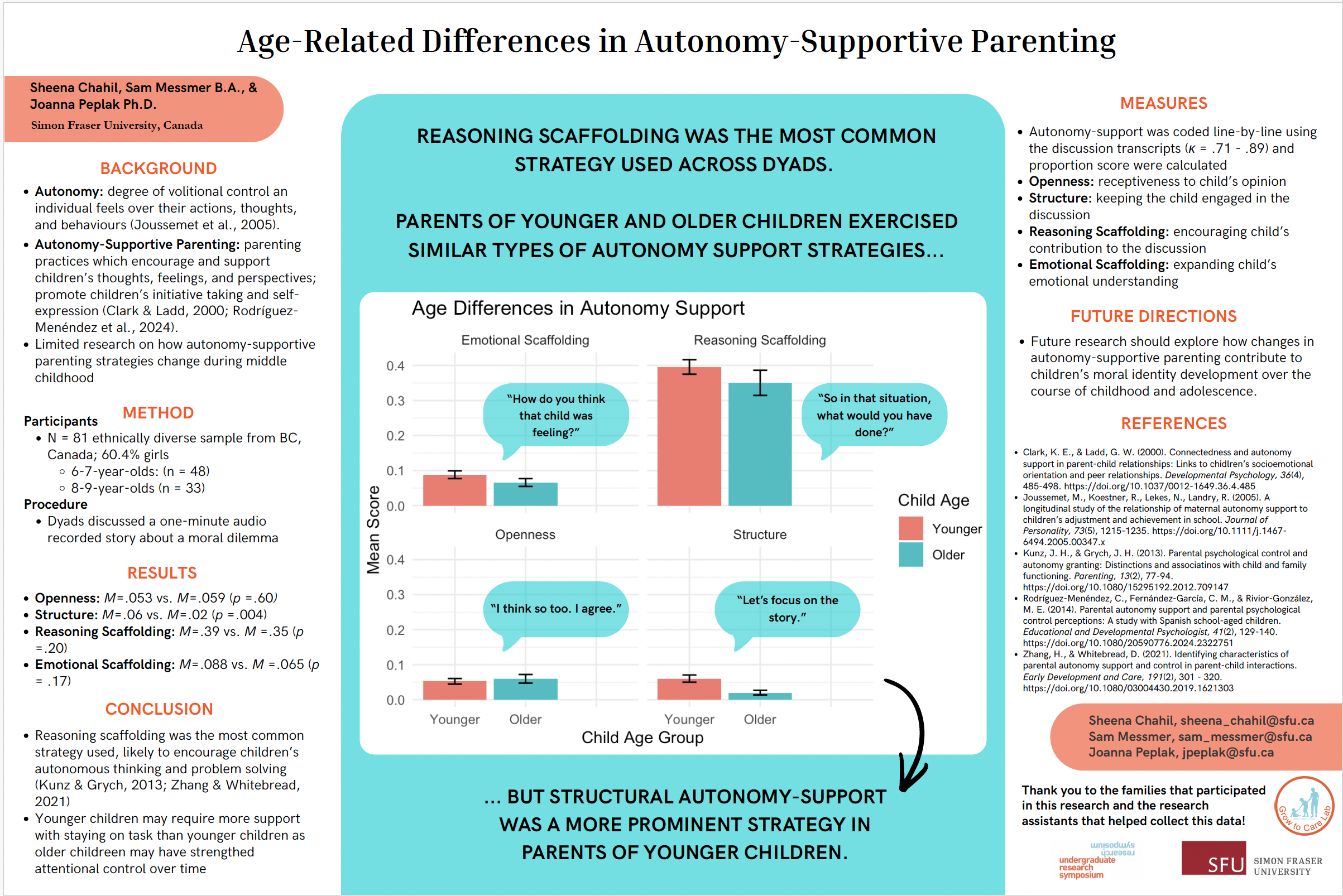
Autonomy is a universal human need important for positive psychological functioning. Autonomy-supportive parenting (ASP) in which parents encourage children’s self-expression and decision making within a structured context, has been linked to children’s increased moral development, better emotion regulation, and higher self-esteem. As children set foot in different developmental periods, the types of autonomy-support needed may also change. Sparse research has examined how specific styles of ASP evolve over the course of middle childhood. In a preliminary analysis of n = 20 (data coding on-going, total N = 110) including children aged 6-9 years old and their primary caregiver, we investigated whether the autonomy-supportive techniques that parents used differed with younger (ages 6-7 years) compared to older children (ages 8-9 years). ASP was coded within parent-child discussions of a moral dilemma and included strategies such as: openness (receptiveness to child’s opinion), structure (keeping the child engaged), non-directiveness (encouraging the child’s contribution to the conversation), and emotional scaffolding (expanding children’s emotional understanding). Preliminary trends revealed that parents engaged in similar levels of openness (M = .10 vs. M = .07), structure (M = .05 vs. M = .03), and non-directiveness (M = .43 vs. M = .44) with younger versus older children, respectively. Emotional scaffolding showed the largest difference (M = .13 vs. M = .07), suggesting that parents employed this type of support more with younger children. Once this work is completed, our insights may shed light on the developmentally appropriate strategies that best nurture their children’s autonomy at different early life stages.
Article Details

This work is licensed under a Creative Commons Attribution-NonCommercial-NoDerivatives 4.0 International License.