
The Effects of Long-Term Trazadone Treatment on Object Recognition in the APPNLF Mouse Model of Alzheimer's Disease
Article Sidebar
Main Article Content
Abstract
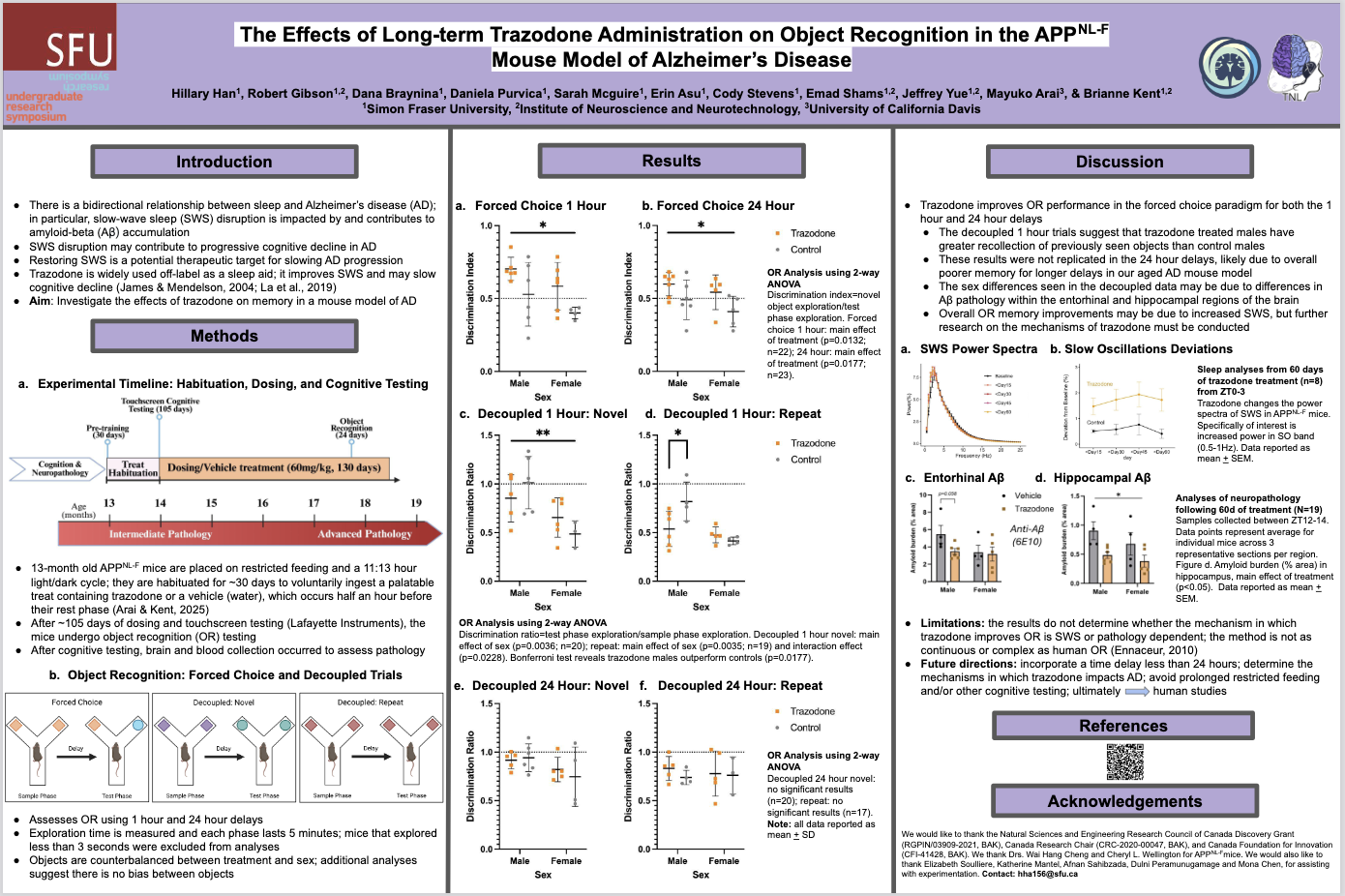
Trazodone is an antidepressant that has been widely used off-label as a sleep aid. Based on previous research within our lab, trazodone has the ability to enhance deep sleep and also reduce amyloid-beta pathology, which are two key features of Alzheimer’s disease (AD). Since trazodone targets these deficits, it could be promising intervention. Furthermore, this study aims to test trazodone’s impact on a third aspect of the disease; cognition. It is hypothesized that long term trazodone treatment will improve object recognition, the ability to recall and identify objects in view. Using APPNL-F mice that are genetically modified to have amyloid-beta plaques, Trazodone was administered daily for over 130 days. Two types of object recognition paradigms were used: forced choice and decoupled. There were also two delays: 1 hour and 24 hours. In the forced choice version, mice were presented with two identical objects and after the delay, they were shown the same object again along with a novel one. In the decoupled version, the repeated and novel objects appear in separate trials. For the repeated trial, the mice were shown the same object pair after the delay and for the novel trial, they were shown a novel pair. The decoupled paradigm is able to differentiate whether there is a deficit with recall or formation of a false memory. Results showed that Trazodone improved object recognition in the forced choice 1 hour trial. These findings contribute to the pre-existing research that supports Trazodone as a promising intervention for AD progression.
Article Details

This work is licensed under a Creative Commons Attribution-NonCommercial-NoDerivatives 4.0 International License.