Did I Make a Difference? The Importance of Perceived Impact and Appreciation of Mentors' Wellbeing
Article Sidebar
Main Article Content
Abstract
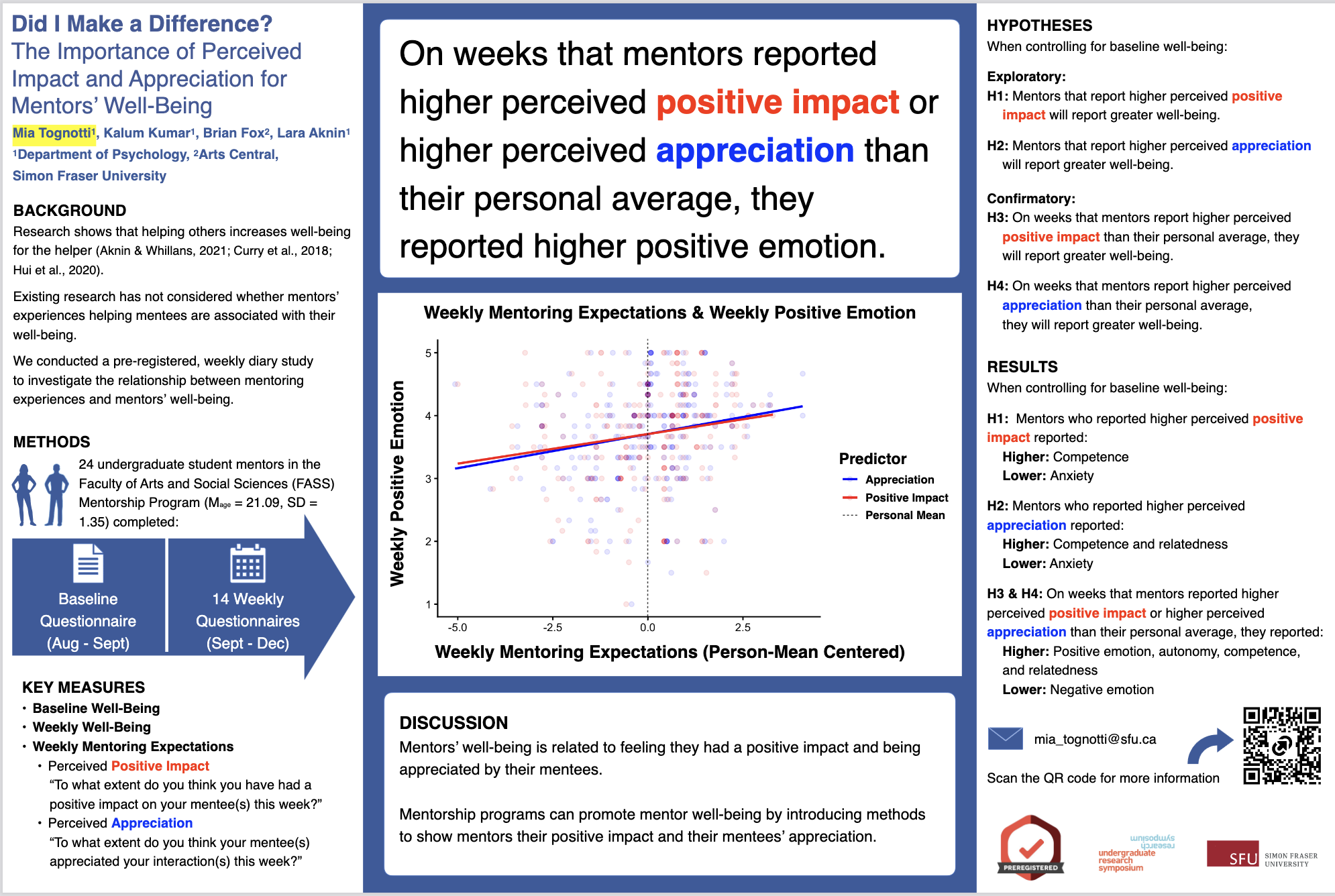
Mentorship involves experienced mentors giving advice, support, and resources to their less-experienced mentees. Despite ample literature suggesting that people experience well-being benefits from helping others (Aknin & Whillans, 2021; Curry et al., 2018; Hui et al., 2020), existing research has not explored the relationship between providing mentorship and mentors’ general well-being. Therefore, we conducted one pre-registered, longitudinal study to examine whether weekly mentoring activity is associated with mentors’ weekly well-being. Twenty-four undergraduate student mentors in a peer mentorship program at SFU completed a baseline survey and 14 weekly surveys in which they reported their mentoring activities and well-being. We then conducted linear mixed-effects modelling to analyze within- and between-subject effects. In line with the preregistered hypotheses, when controlling for baseline happiness, on the weeks that mentors reported greater expected appreciation from their mentees or greater perceived positive impact on their mentees than their personal average, they tended to report higher positive affect, lower negative affect, higher autonomy, higher competence, and higher relatedness. Additionally, when controlling for baseline happiness, mentors who reported greater expected appreciation on average tended to report lower anxiety, higher competence, and higher relatedness. Similarly, when controlling for baseline happiness, mentors who reported greater perceived positive impact on average reported lower anxiety and higher competence. These findings suggest that mentors’ perception of the impact and appreciation of the help they provide is important for their well-being. Thus, mentorship programs may consider implementing strategies to inform mentors of their positive impact and their mentees’ appreciation to maximize mentors’ well-being.
Article Details

This work is licensed under a Creative Commons Attribution-NonCommercial-NoDerivatives 4.0 International License.