
Effect of Ferry Activity on Brandt’s Cormorant Foraging Behavior
Article Sidebar
Main Article Content
Abstract
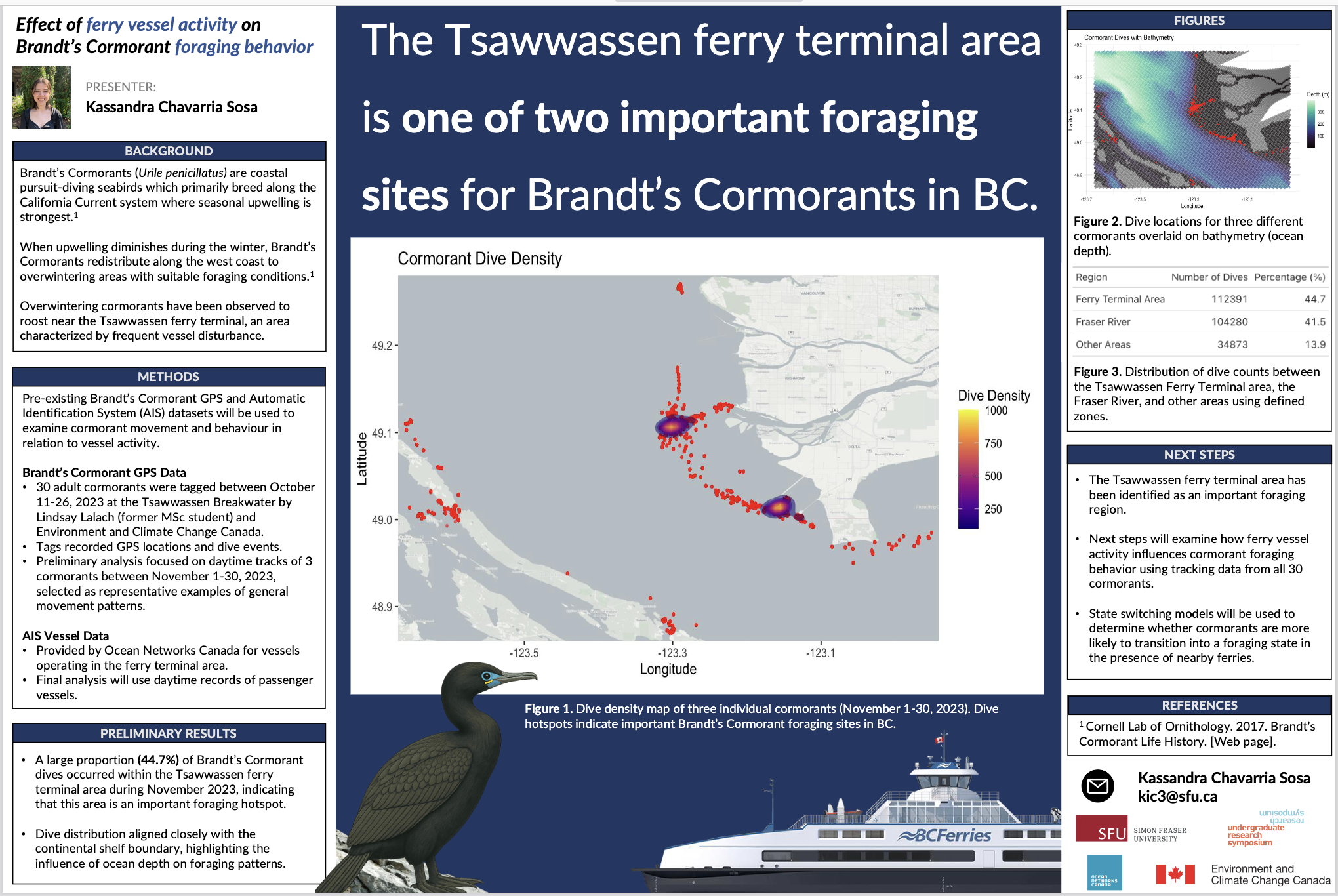
The poster will present the introduction, methods, and early findings of an ongoing research project that will be conducted throughout the Spring 2026 semester. This research will examine how ferry activity affects foraging behavior of Brandt’s Cormorants (Urile penicillatus; BRAC) at the Tsawwassen ferry terminal in Delta, British Columbia.
BRACs are coastal pursuit-diving seabirds that primarily breed along the California Current system, where coastal upwelling is strongest.1 During the winter, southern British Columbia receives a large overwintering population.2 Although vessel traffic has been shown to have negative effects on seabirds, BRACs have been repeatedly observed resting and foraging near the Tsawwassen ferry terminal, an area characterized by frequent ferry activity.
This research will use existing GPS tracking data collected by Environment and Climate Change Canada in 2023 using tags that recorded location data at 10-minute intervals for 30 BRAC individuals. These cormorants were tagged at the Tsawwassen ferry jetty and tracked for 3 months. Data points approximately 2 km away from the Tsawwassen terminal will be isolated and compared with a record of ferry departures and arrivals within the 3-month tracking period. This record will be collected from Ocean Networks Canada, which collects real-time vessel traffic information.
By comparing BRAC movement and foraging during ferry presence and absence, this study aims to determine whether nearby ferry activity influences foraging patterns in BRACs. Understanding this species-specific response is essential for addressing current knowledge gaps and helps inform future management and conservation to protect this provincially red-listed seabird in the Salish Sea.
Article Details

This work is licensed under a Creative Commons Attribution-NonCommercial-NoDerivatives 4.0 International License.