
From Procedure to Policy: The Policy Impacts of Charter Infringements
Article Sidebar
Main Article Content
Abstract
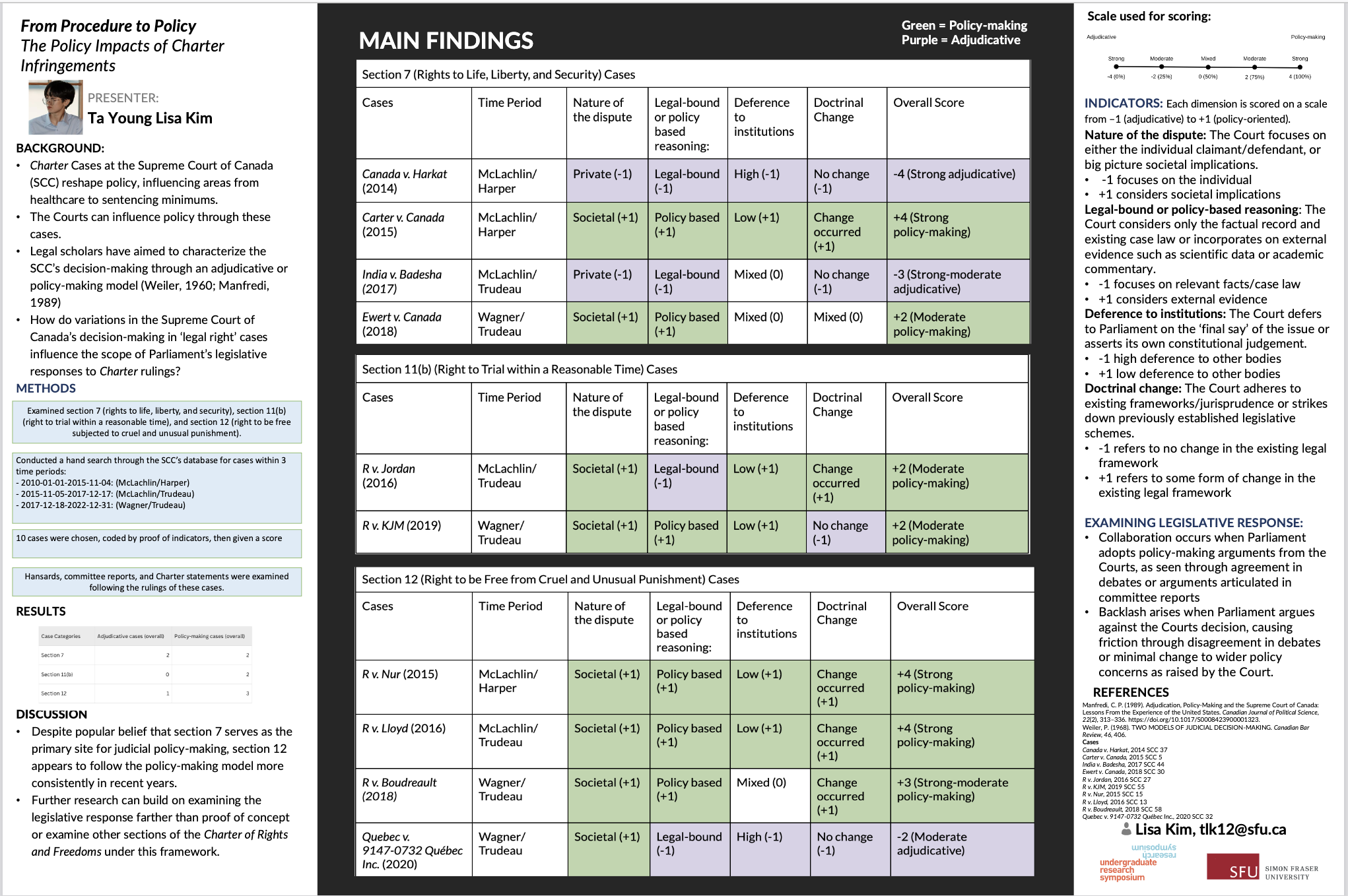
The Supreme Court of Canada (SCC) has been widely regarded as an influential institution within Canada’s political landscape. He Court’s policy impact frequency emerges through legal litigation, where the Court will typically evaluate the validity of a piece of legislation and issue declarations of invalidity that require parliament to amend the impugned law. Within the Canadian Charter of Rights and Freedoms, the legal rights provisions (sections 7 to 14) are traditionally understood as procedural safeguards for individuals who are investigated, detained, or subjected to legal restrictions of any kind. These rights are often contrasted with the Charter’s fundamental freedoms, such as freedom of expression or religion, which are more substantive in nature.
Despite their procedural character, section 7 rights, which protect life, liberty, and security of the person, have become a central vehicle through which the SCC has shaped major public policy debates. Landmark decisions, including those concerning medical assistance in dying (MAID), illustrate the Court’s willingness to interpret section 7 broadly, resulting in significant legislative and social consequences. This development raises an important question: How does the Supreme Court of Canada’s rigid interpretation of legal rights such as sections 11 and 12 contrast with the more policy‑engaged and activist trajectory of section 7 jurisprudence?
This Honours project undertakes a qualitative legal analysis of SCC decisions from 2010 to 2025 in which declarations of invalidity were issued within section 7, 11, and 12 cases.
Article Details

This work is licensed under a Creative Commons Attribution-NonCommercial-NoDerivatives 4.0 International License.