Im-perfect Sync: Autonomic Conflict and Cardiac Responses to Artistic Swimming
Article Sidebar
Main Article Content
Abstract
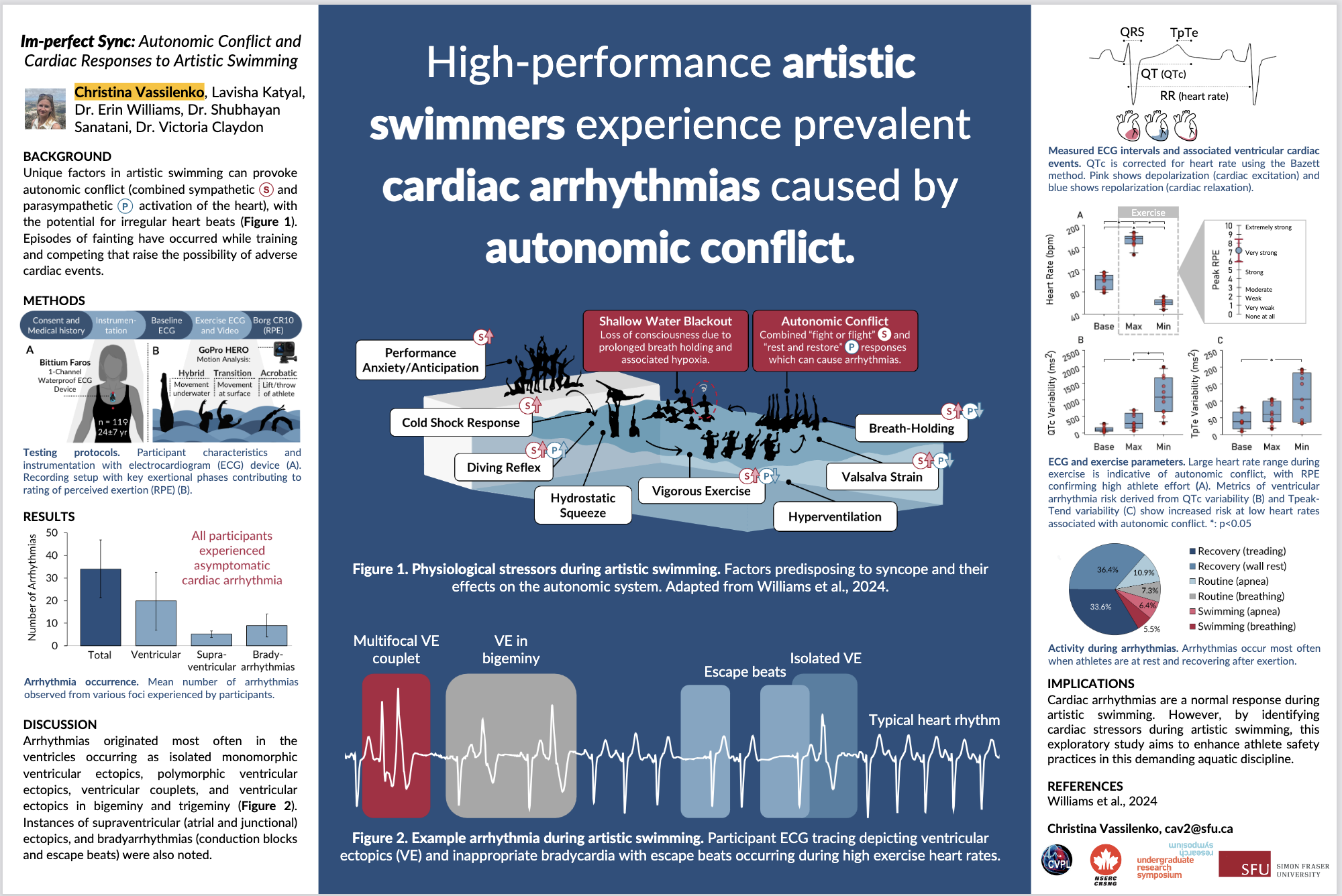
Artistic swimming combines intense physical exertion and prolonged breath-holding, and can provoke autonomic conflict (combined sympathetic “fight and flight” and parasympathetic “rest” activation of the heart) with the potential for irregular heart beats. Indeed, several high-profile episodes of loss of consciousness have occurred while training/competing that raise the possibility of adverse cardiac events. We aimed to investigate cardiac responses in artistic swimmers.
We monitored heart rate and rhythm using a waterproof ECG monitor in high-performance artistic swimming athletes during a typical ~90-minute training session. Training was filmed using a waterproof action camera. Following training, athletes provided ratings of perceived exertion (RPE) using the Borg Scale.
All participants (n=7; female; age 21±7 years) experienced asymptomatic cardiac arrhythmia without loss of consciousness, most commonly extra beats in the ventricles. These occurred as isolated monomorphic ventricular ectopics, polymorphic ventricular ectopics, ventricular couplets, and runs of ectopic activity occurring in ventricular bigeminy and trigeminy. Instances of supraventricular ectopics, conduction blocks, and escape beats were also noted. The maximum heart rate was 179±6 bpm and interspersed with periods of bradycardia, with a minimum heart rate of 65±16 bpm, presumably reflecting autonomic conflict. Metrics of variable cardiac repolarization indicative of arrhythmia risk were increased during minimum heart rates. Participants reported a peak RPE of 7.6±1.3 (“very strong”), noting the training session was unremarkable.
By identifying cardiac stressors and arrhythmic events triggered during artistic swimming, this exploratory study aims to enhance athlete safety, inform training practices, and contribute to optimizing performance in this demanding aquatic discipline.
Article Details

This work is licensed under a Creative Commons Attribution-NonCommercial-NoDerivatives 4.0 International License.