
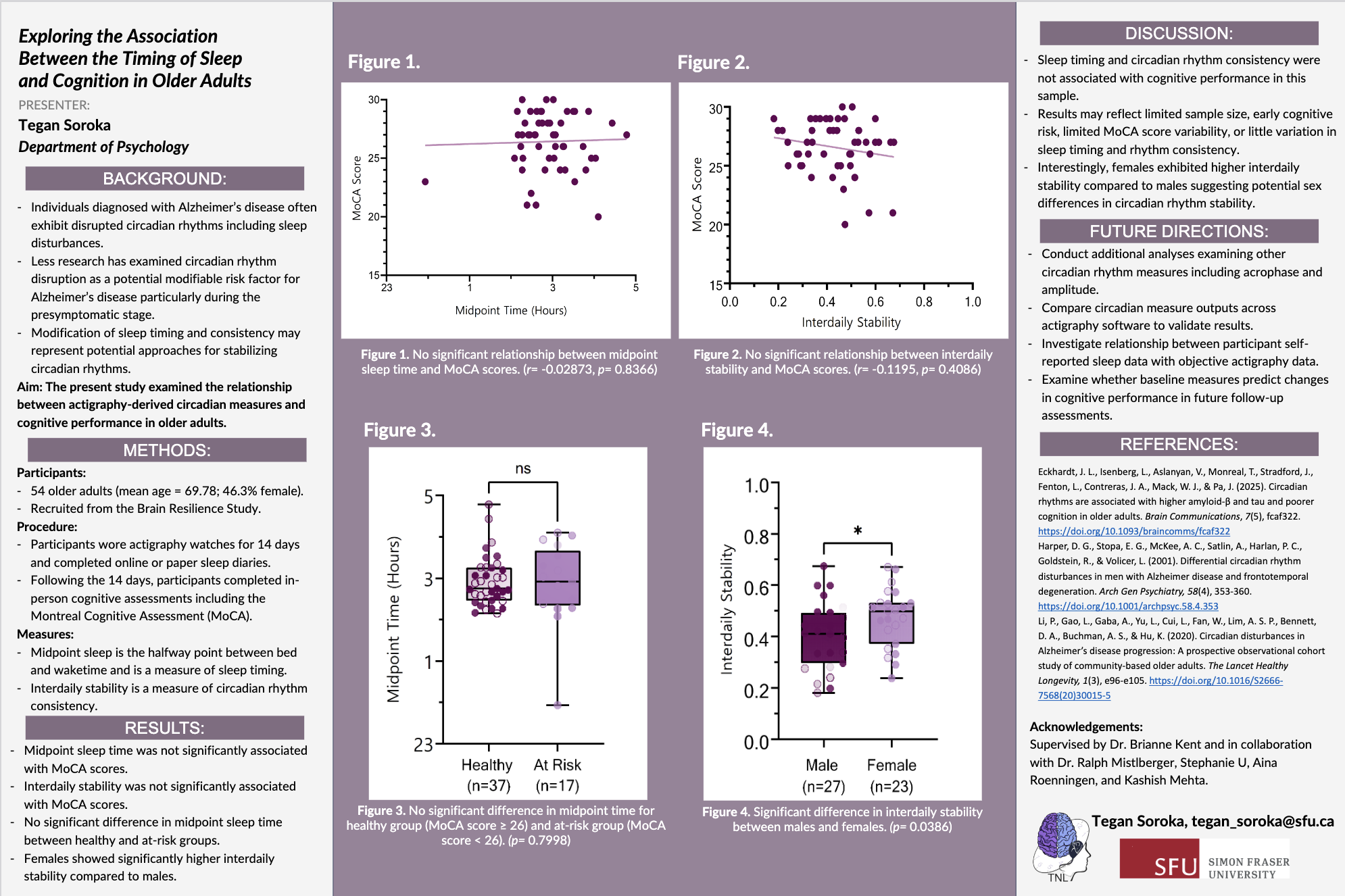
Exploring the Association Between the Timing of Sleep and Cognition in Older Adults
Article Sidebar
Main Article Content
Abstract
Previous studies have found that circadian rhythms often appear disrupted in individuals diagnosed with Alzheimer’s disease. Less research has examined whether circadian rhythms may also act as a modifiable risk factor during the early stages of Alzheimer’s disease prior to the onset of cognitive symptoms. To explore the association between circadian rhythms and cognitive performance, the current study included 55 participants aged 50 years and older (mean age = 69.7 years, 47.3% female, 52.7% male). Participants wore activity monitoring watches for 14 consecutive days and completed daily sleep diaries. Participant cognitive performance was assessed using the Montreal Cognitive Assessment (MoCA) which is a widely used screening tool for cognitive impairment. From the activity and sleep diary data, average sleep timing and consistency of sleep between nights were calculated. Analyses examined associations between cognitive performance scores and measures of sleep timing and consistency while accounting for age and sex. Findings may suggest that circadian rhythm regulation, specifically through the modification of sleep timing and consistency, represents a potentially modifiable early risk factor that could aid in Alzheimer’s disease prevention.
Article Details

This work is licensed under a Creative Commons Attribution-NonCommercial-NoDerivatives 4.0 International License.