
Investigating How the Brain Allocates Attention to Spatially and Temporally Salient Stimuli Across Time
Article Sidebar
Main Article Content
Abstract
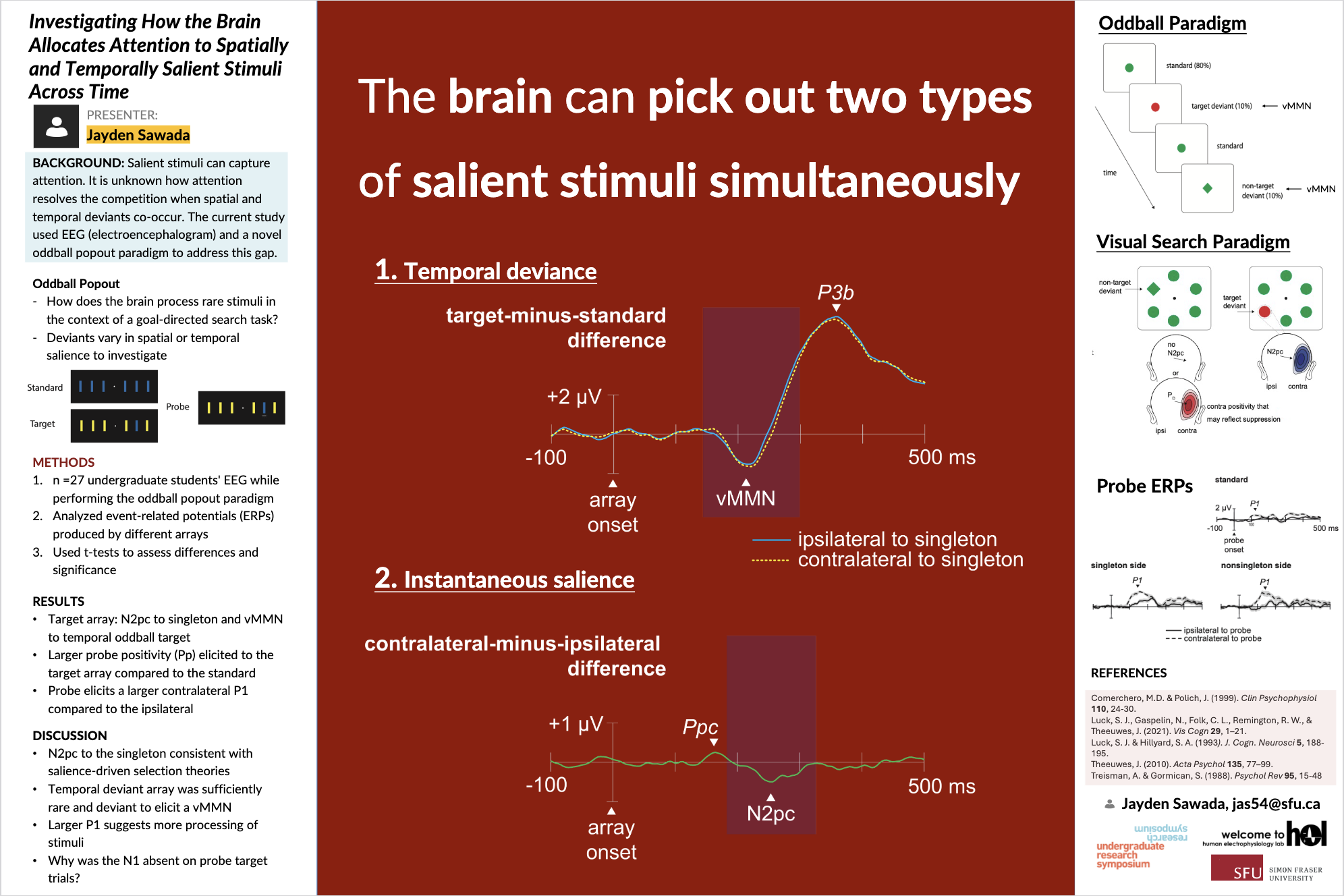
Visual environments contain rapidly changing information across both space and time. This presents the human attentional system with the challenge of prioritizing relevant events while managing distractions. Spatially and temporally salient stimuli have traditionally been studied separately using visual search and oddball paradigms, respectively. However, little is known about how the brain resolves competition when these two forms of salience occur simultaneously. The present study introduces a novel oddball-popout paradigm that combines temporal salience with a spatial deviant to test whether these signals compete within a shared attentional priority map or rely on distinct independent processing pathways. Participants viewed sequences of standard displays that contained six blue bars and responded to an infrequent target display of five yellow bars and one blue bar. Yellow bars were the temporal target, and the blue bar was salient within the target display. Electroencephalography was used to measure event-related potentials (ERPs) to determine whether participants attended to the relevant targets, irrelevant items, or both. ERPs analyzed include those associated with temporal deviance detection (vMMN), spatial attention selection (N2pc), distractor suppression (PD) and early sensory processing. If spatial and temporal salience rely on distinct attentional resources, it is expected that the oddball stimuli will elicit a vMMN and the spatial singleton will elicit an N2pc or PD. These results would challenge winner-take-all models of attention and suggest that spatial and temporal salience are processed in parallel. The findings have implications for theoretical models of attention and can guide the design of equipment that requires multitasking.
Article Details

This work is licensed under a Creative Commons Attribution-NonCommercial-NoDerivatives 4.0 International License.