
Public Space, Private Rules: Rethinking the Right to the City
Article Sidebar
Main Article Content
Abstract
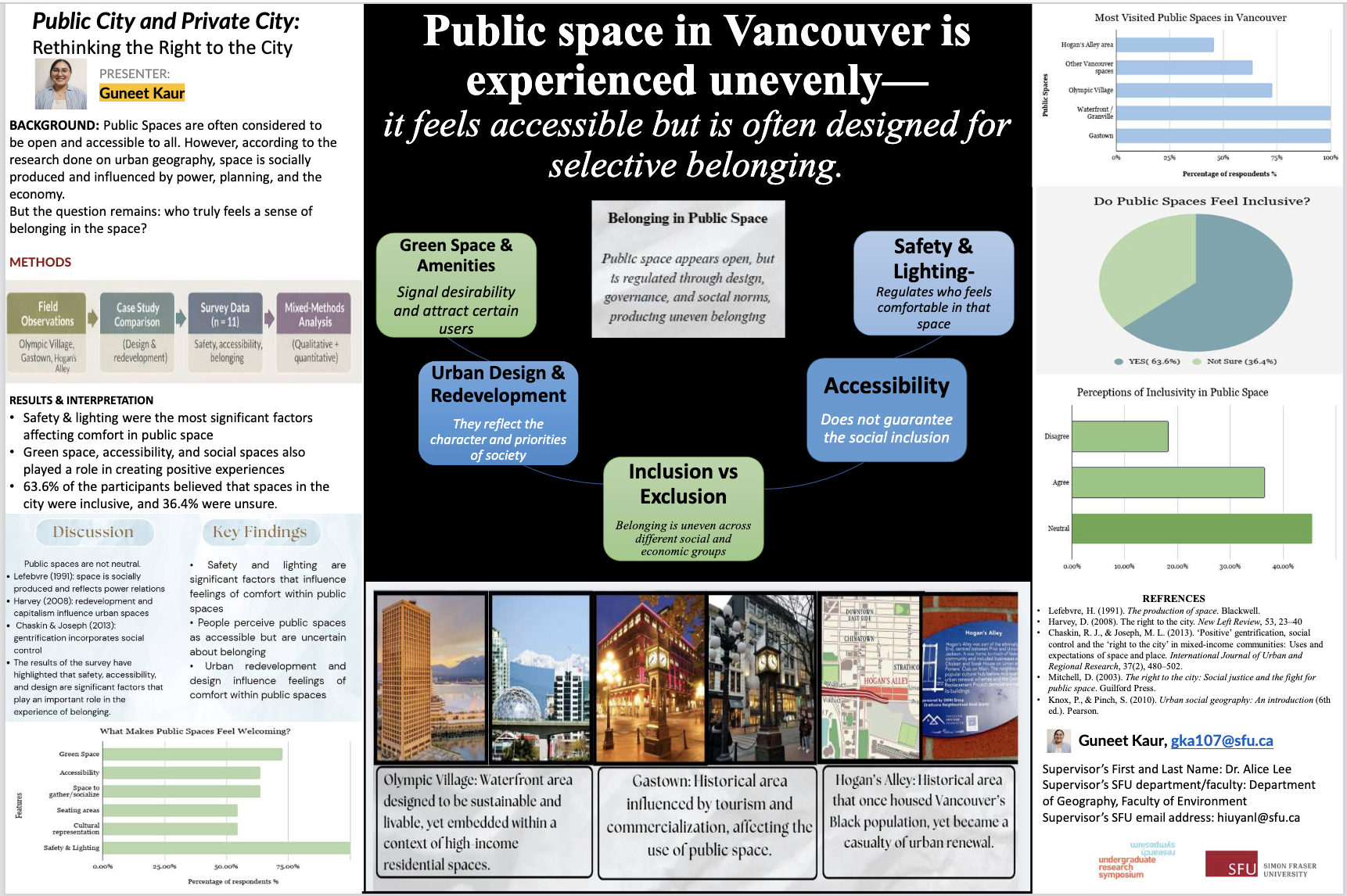
The 'Right to the City' emphasizes equitable access, participation, and use of urban space for all residents; however, these rights are unevenly realized in everyday civic environments. This research investigates how regulations and management practices in public spaces shape the lived experience of this right. The central research question guiding this study is: How do regulatory and design practices in public spaces influence who can meaningfully exercise the Right to the City?
Drawing on critical urban geography and social geography, the project focuses on three types of civic spaces: downtown plazas, public libraries, and waterfront areas. Although these spaces are formally open to the public, they are governed through design features, surveillance practices, and behavioral rules that structure acceptable forms of use and presence.
The study employs qualitative methods, including observation of public space use and interviews/surveys with space users. Observations examine who uses these spaces, how they are used, and how rules are enforced in practice, while interviews explore users’ perceptions of access, comfort, and belonging. Together, these methods allow for an analysis of how regulation operates both materially and experientially.
By shifting attention away from housing-focused analyses, this research highlights how the Right to the City is negotiated through the regulation of public space. The findings demonstrate that legal openness does not ensure meaningful access, as governance and spatial control play a central role in determining who can legitimately occupy and use urban civic spaces.
Article Details

This work is licensed under a Creative Commons Attribution-NonCommercial-NoDerivatives 4.0 International License.