
Reliability of 3D Scanned Breast Volume Measurements Within and Between Raters
Article Sidebar
Main Article Content
Abstract
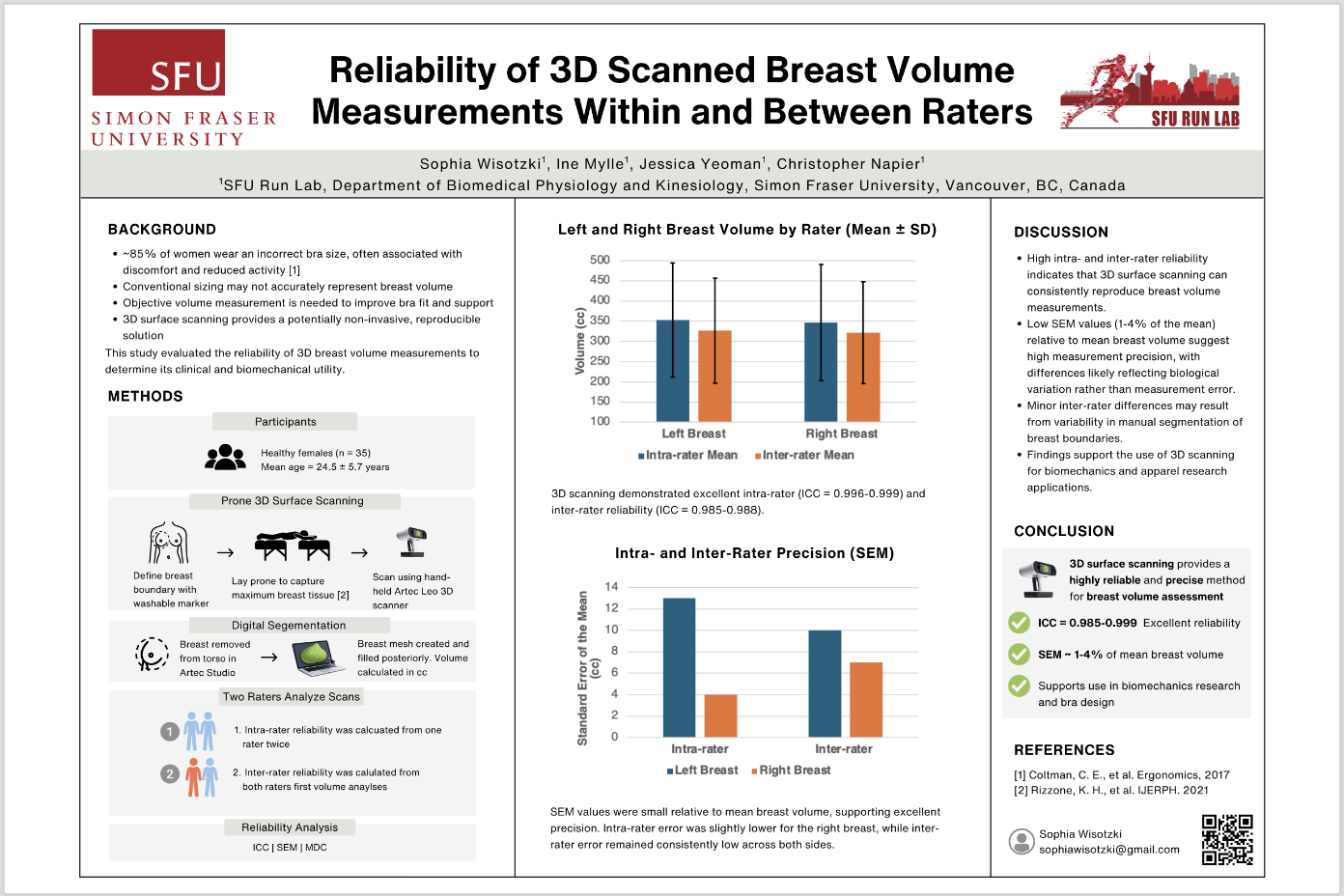
Inadequate breast support is associated with pain, discomfort, and reduced participation in physical activity; however, approximately 85% of women wear an incorrect bra size [1,2]. Accurate breast volume measurement is a critical component of effective bra design, yet traditional sizing methods rely on limited linear measurements that fail to capture three-dimensional (3D) breast shape and volume. 3D surface scanning offers a non-invasive and reproducible alternative for quantifying breast volume and morphology [1]. This study evaluated the intra- and inter-rater reliability of breast volume measurements derived from 3D surface scans to determine the consistency and practical usability of this method.
METHODS
Healthy female participants (24.5 ± 5.7 years) underwent prone 3D surface scanning using a handheld scanner (Artec Leo, Artec, Luxembourg) after breast boundaries were outlined with a washable marker [2]. Breast meshes were created in Artec Studio by tracing the marked boundary, digitally separating the breast from the torso, and reconstructing the posterior chest wall [1]. Breast volumes were calculated in cubic centimeters (cc). A total of 70 scans were analyzed twice by a single rater to assess intra-rater reliability, and a subset of 19 participants was independently analyzed by two trained raters to assess inter-rater reliability. Reliability was quantified using intraclass correlation coefficients (ICC), and measurement precision was evaluated using the standard error of measurement (SEM) and minimal detectable change (MDC).
RESULTS
Breast volumes ranged from 130-796 cc (left) and 108-808 cc (right) for intra-rater analyses, and 130-593 cc (left) and 108-596 cc (right) for inter-rater analyses. Excellent intra-rater (ICC = 0.996-0.999) and inter-rater reliability (ICC = 0.985-0.988) were observed, with low SEM and MDC values across all measurements.
DISCUSSION
Three-dimensional surface scanning demonstrated excellent reliability and high measurement precision for breast volume assessment. These findings support the use of 3D scanning as a robust tool for breast biomechanics research and have important implications for improving bra sizing, breast support, and future design applications. Future work should evaluate the validity of this method against gold-standard imaging techniques and explore its application in both clinical and performance-based contexts.
Article Details

This work is licensed under a Creative Commons Attribution-NonCommercial-NoDerivatives 4.0 International License.