
Small Bones, Big Questions: Sex Estimation in Juvenile Skeletons
Article Sidebar
Main Article Content
Abstract
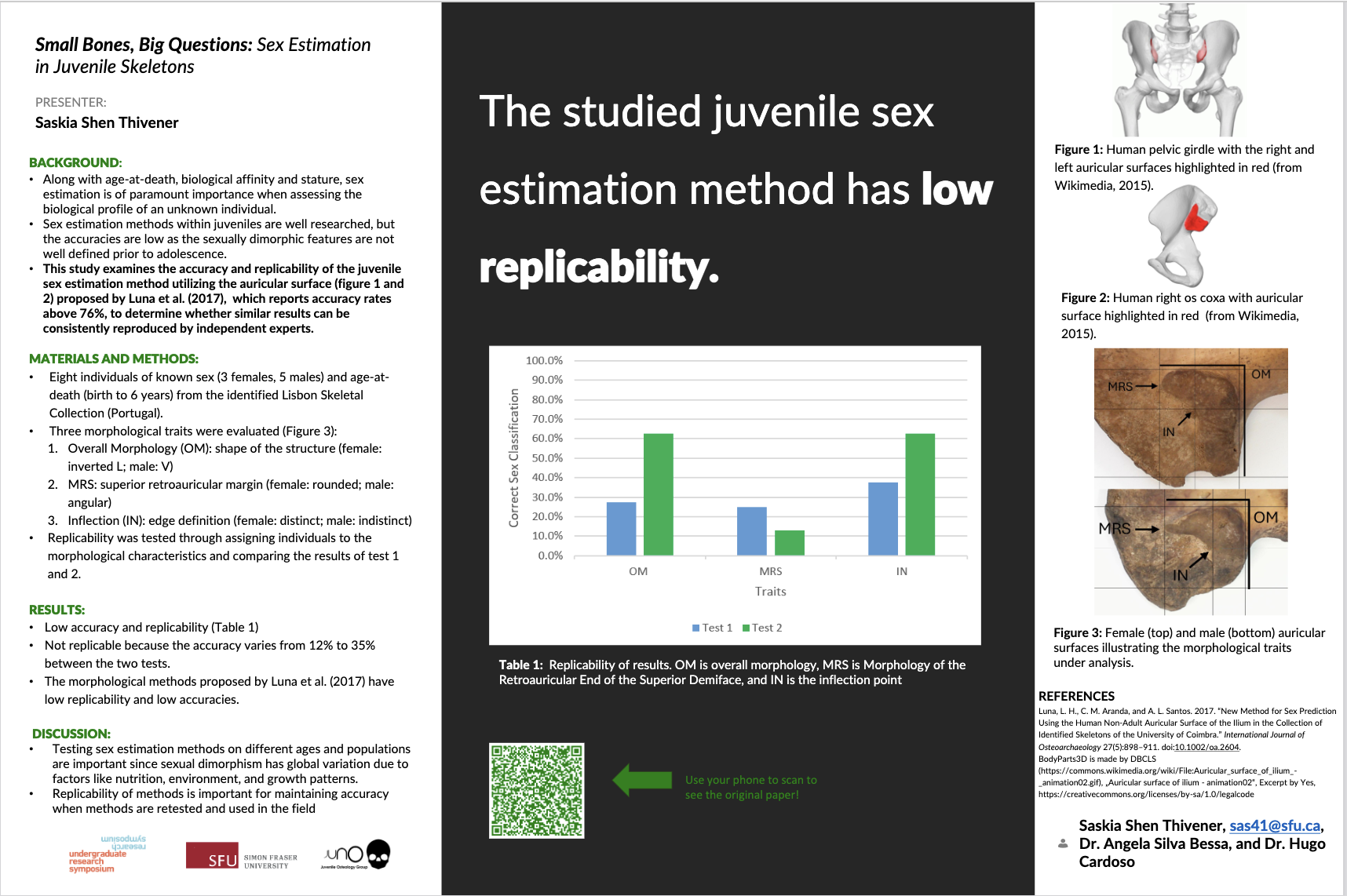
Sex estimation is a key factor that aids in the identification of unknown remains in bioarchaeology and forensic anthropology. In juvenile skeletal remains sex estimation is a significant challenge because skeletal sex features are not fully developed. Recent research, however, has suggested that sexually dimorphic traits are quantifiable earlier in life. Using photographs of the ilia taken from juvenile remains (0-12 years of age) curated at the National Museum of Natural History and Science, Lisbon, Portugal, this study examines the replicability of a proposed sex estimation. A method that is based on the visual and digital measurements of the auricular surface of the ilium. This research relies on the methodology proposed by Luna et al. (2017), along with subsequent changes by Monge Calleja et al. (2020), Luna et al. (2021), and Monge Calleja et al. (2025).
Independently conducted, this study assesses whether the proposed measurements are consistently observable and reproducible outside of testing done by the original authors. Preliminary findings from comparisons of data from test 1 and test 2 indicate low replicability, since several of the defined auricular surface landmarks are not present or clearly identifiable in all individuals. Ultimately this study highlights the importance of testing osteological methods across samples and examiners before broad application.
Article Details

This work is licensed under a Creative Commons Attribution-NonCommercial-NoDerivatives 4.0 International License.