
White-collar crime: Criminal fraud in corporate settings
Article Sidebar
Main Article Content
Abstract
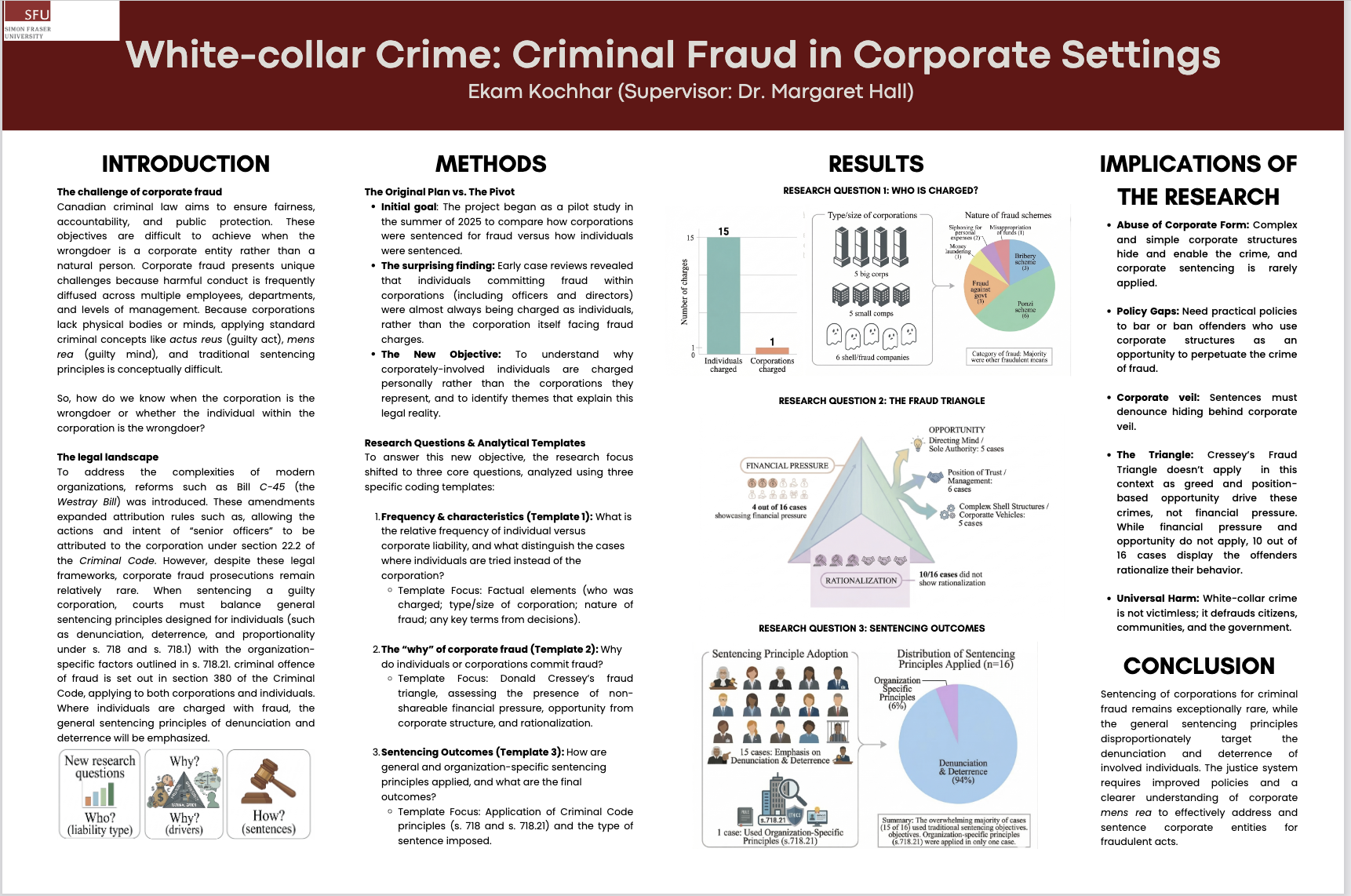
Fraud remains a persistent threat in Canada, affecting approximately 8% of the population. Under the Criminal Code of Canada, both individuals and corporations can commit fraud. Using thematic template analysis of Canadian case law, this research explores the sentencing of individuals and corporations for criminal fraud committed in corporate settings. My preliminary findings indicate that corporately involved individuals are charged significantly more often than the corporation itself. In these cases, corporate directors and other senior officers use the corporate structure to commit fraud and benefit themselves rather than the corporation. Many of these corporations are one-man sham corporations created for the purpose of committing fraud specifically and then dissolved. My research also considers how sentencing principles are applied in these cases. Section 718 sets out sentencing principles of general application, applying to individuals and corporations. Section 718.21 sets out our additional organization-specific sentencing principles applying to corporations, taking into consideration that they are artificial persons that cannot be imprisoned like natural persons. These findings deepen our understanding of the meaning of corporate fraud and suggest the need to address these individuals using the corporate structure for their own benefit. The findings also have law reform related implications that there is a need to make it hard or ban individuals from creating numbered companies to perpetuate criminal fraud, on a case-by-case basis.
Article Details

This work is licensed under a Creative Commons Attribution-NonCommercial-NoDerivatives 4.0 International License.