The Mechanisms of Preparatory Attention and Visual Working Memory Capacity on Attention
Article Sidebar
Main Article Content
Abstract
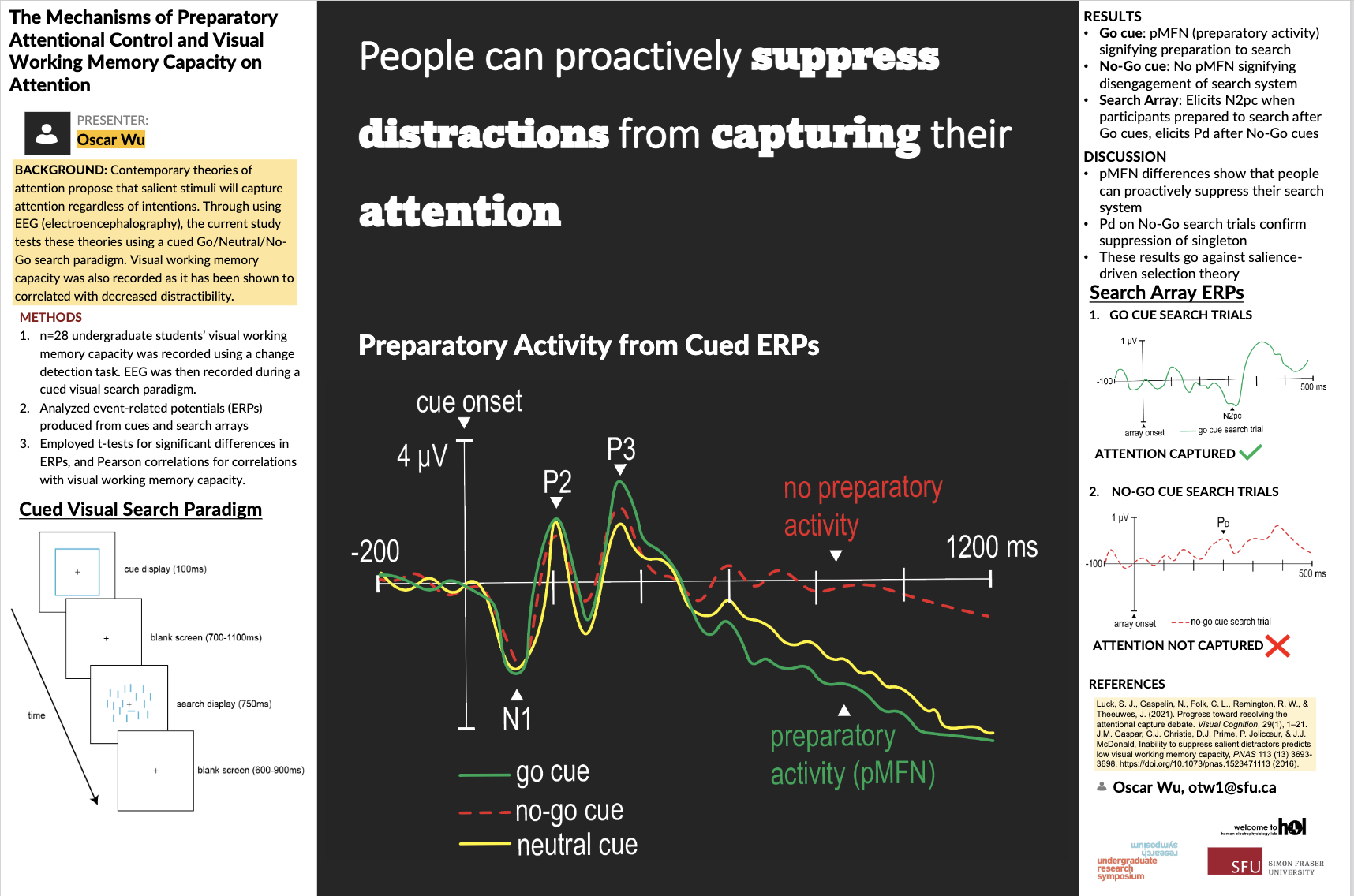
The ability to avoid distractions is essential safe and effective behaviour. Current research on attention has theorized that people can prepare their attention ahead of time to help them avoid looking at irrelevant objects or respond quicker to relevant ones. However, the neural mechanisms and individual differences behind these skills are unclear. The present study investigates how advance information about upcoming visual stimuli can influence attention, and if visual working memory capacity can strengthen these influences. Participants will complete a change detection task to record visual working memory capacity score. They will then complete a visual search task where they will be visually instructed to respond, ignore, or given no prior information to viewing a display that contains a salient distractor. During this, electroencephalography will be used to record brain activity and will be used to generate event-related potentials. Event-related potentials associated with attentional enhancement and suppression will be analyzed to determine how attention processes change based on advance instructions. Findings will clarify if preparatory attention for enhancing and suppressing stimuli are activated through separate attentional systems within the brain. Furthermore, it will determine if differences in visual working memory capacity can predict differences in visual search, and if these differences can be compensated through having advanced information.
Article Details

This work is licensed under a Creative Commons Attribution-NonCommercial-NoDerivatives 4.0 International License.