The Pie Game: A New Economic Game Exploring the Complexity of Real-World Financial Generosity
Article Sidebar
Main Article Content
Abstract
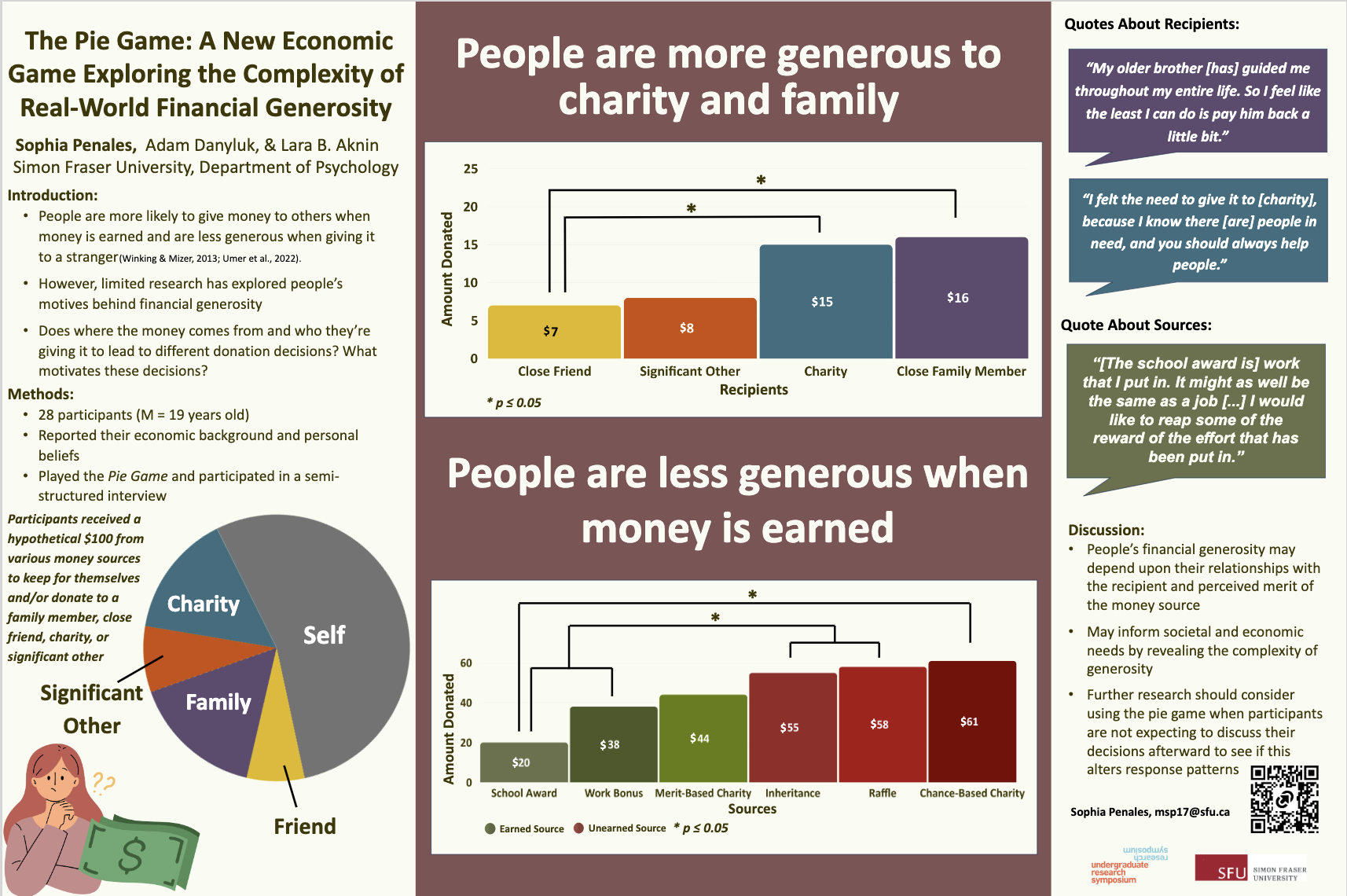
While giving money to others is a widespread phenomenon, there is little research on the motives behind people's financial generosity in everyday scenarios. For instance, does the source of the money and who one spends it on play a role in people’s generosity? We used a mixed-methods approach to address this question. First, 30 participants completed an online survey about themselves, their economic background, and their views on economic inequality. Then, they played the pie game, a novel economic game that presents participants with multiple real-world scenarios, in which they receive $100CAD each time from a named money source (e.g., work bonus). With each source, participants decided how much money to keep for themselves and/or distribute across several recipients they had identified (e.g., a friend) simultaneously. After each decision, they rated their momentary happiness and sense of control. Finally, participants shared their thoughts, motivations, and emotions experienced during the game in a follow-up interview. While data analysis is ongoing, we will compare the amounts given to each recipient across all sources and the total amount spent from each source across all recipients, respectively. These quantitative results will be complimented by emergent themes from the interviews to comprehensively capture people’s spending motives and how they feel about their decisions. This study aims to provide insight into the complexities behind real-world financial generosity and explore the nuances between people’s thoughts and behaviours. These findings may help to address societal and economic needs by uncovering the driving forces behind everyday financial generosity.
Article Details

This work is licensed under a Creative Commons Attribution-NonCommercial-NoDerivatives 4.0 International License.