The Politics of Recognition: Explaining Divergent Legitimacy Outcomes in African Self Determination Movements
Article Sidebar
Main Article Content
Abstract
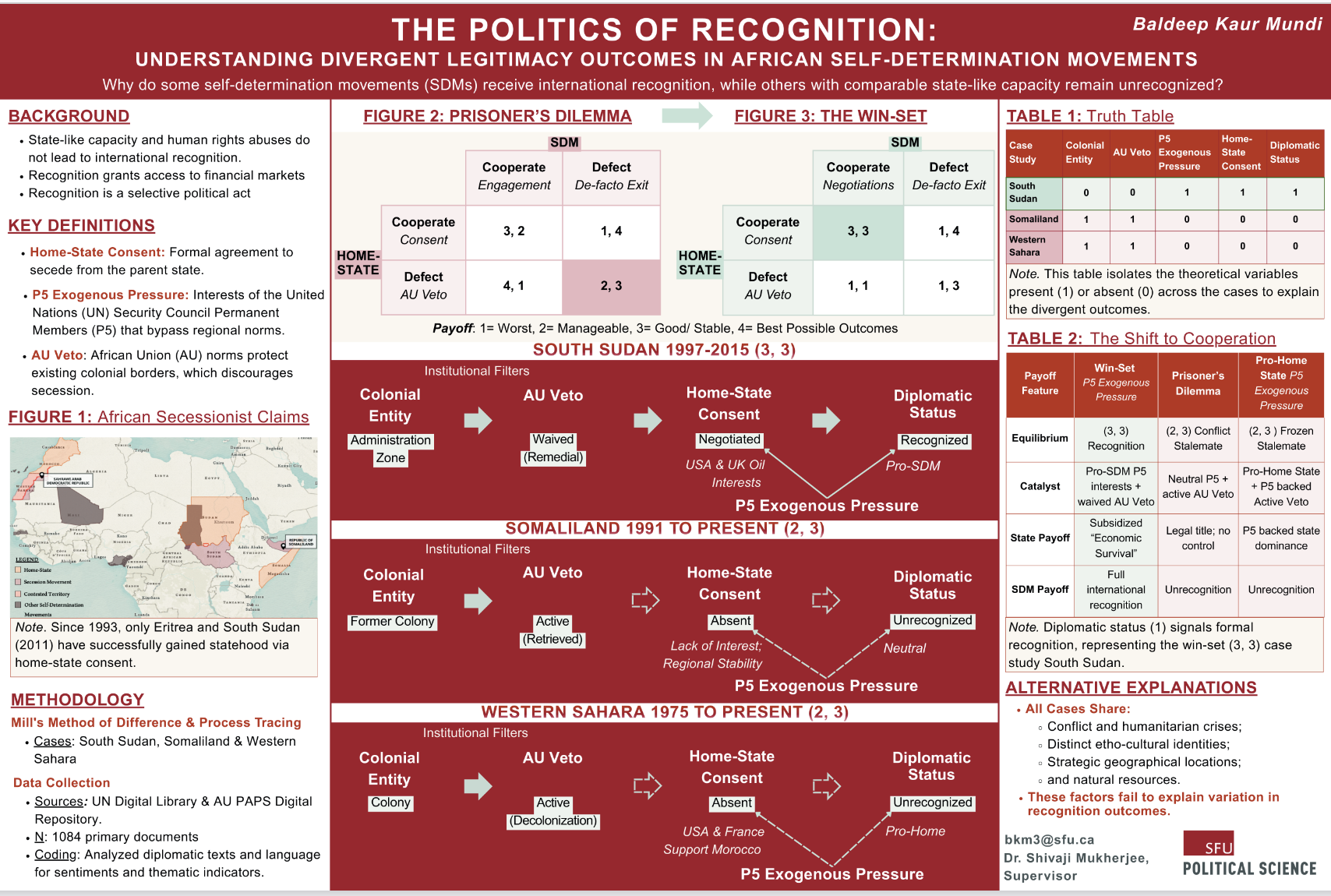
The international system faces a persistent tension between the principle of self-determination and the norm of territorial integrity, producing uneven outcomes for secessionist movements. While South Sudan achieved widespread recognition in 2011, territories such as Somaliland and Western Sahara remain largely unrecognized despite exhibiting key attributes of statehood. This project examines why some self-determination movements receive international recognition while others with comparable state-like capacity do not, focusing on the interplay of geopolitical interests, home-state consent, and African Union (AU) institutional constraints.
Using a multi-level games framework, the poster argues that recognition outcomes in Africa are shaped less by legal compliance than by a highly constrained regional political environment. The AU’s commitment to preserving inherited colonial borders functions as a strong institutional norm that discourages secession, effectively granting home-states effective veto power over recognition. Recognition, therefore, is a selective and political process requiring strong strategic incentives to override territorial integrity norms.
The poster presents a comparative analysis of South Sudan, Somaliland, and Western Sahara using process tracing to map key diplomatic decisions, institutional pressures, and moments of recognition or exclusion. Visual timelines and tables, drawing on a combination of United Nations and AU documents, official statements, and quantitative conflict and governance data, illustrate how geopolitical interests and negotiated consent enabled South Sudan’s recognition, while similar outcomes remain foreclosed in the other cases. The project contributes to broader debates on sovereignty, legitimacy, and post-conflict state formation in Africa.
Article Details

This work is licensed under a Creative Commons Attribution-NonCommercial-NoDerivatives 4.0 International License.