
Touchscreen-Based Assessment of Cognitive Impairment in Alzheimer’s Disease Mouse Models
Article Sidebar
Main Article Content
Abstract
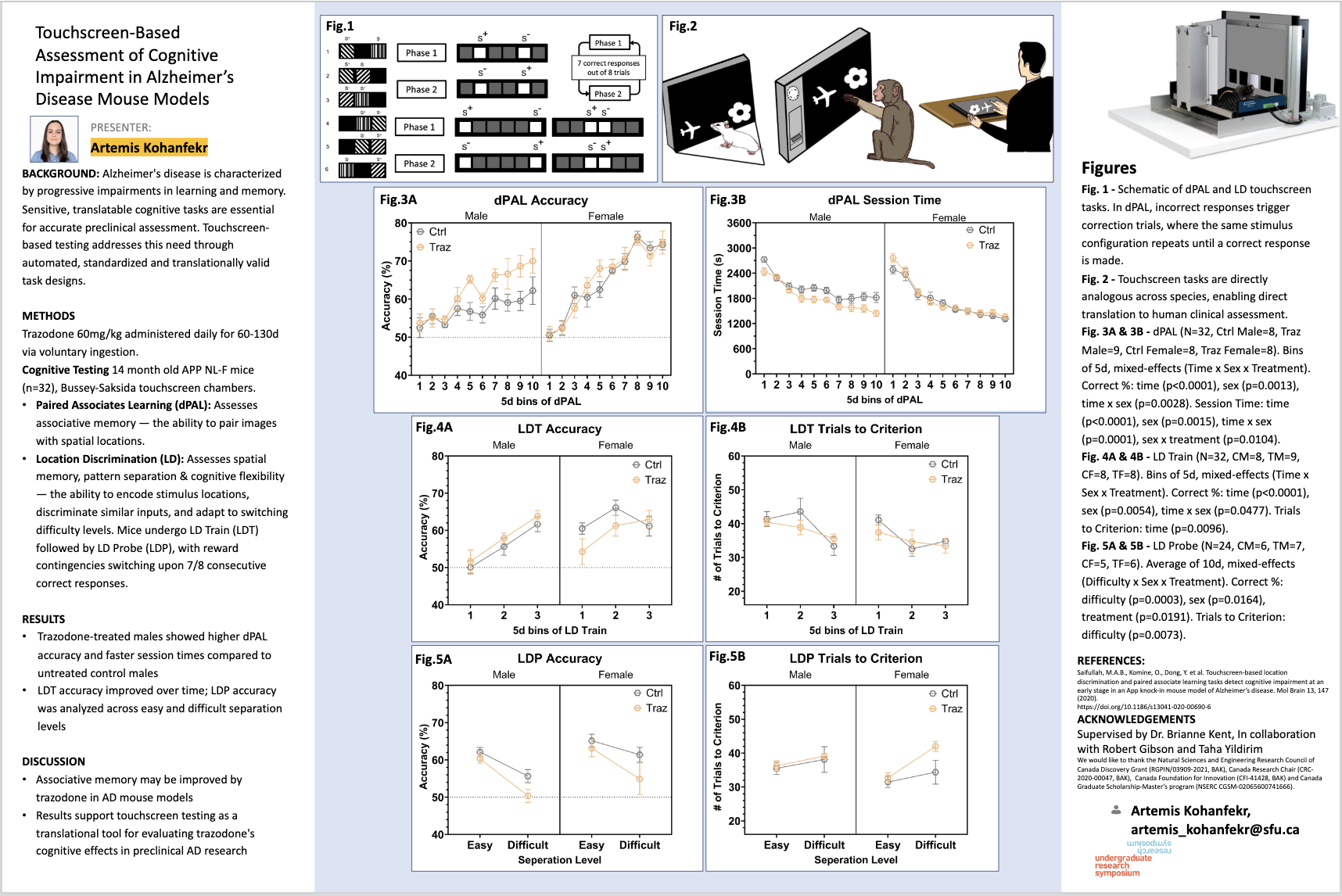
Alzheimer’s disease (AD) is a neurodegenerative disorder characterized by progressive impairments in learning and memory. Hallmark pathological features of the disease include amyloid-β plaque accumulation and tau pathology, which contribute to widespread neural dysfunction and cognitive decline. Sleep disturbances, particularly reductions in slow-wave sleep (SWS), are common in individuals with AD and have been associated with cognitive impairment. As a result, restoring SWS has been proposed as a potential strategy to support cognitive function in AD. Trazodone is a commonly prescribed antidepressant that is frequently used to manage sleep disturbances due to its hypnotic effects, which are thought to be primarily mediated through antagonism of 5-HT₂A receptors. Assessing whether sleep-modulating interventions have the potential to be considered disease-modifying in AD requires sensitive and translational behavioural measures. Touchscreen-based cognitive testing provides an automated and standardized approach to evaluating cognitive domains commonly affected in AD. In particular, the Paired Associates Learning (PAL) task assesses associative learning, while the Location Discrimination (LD) task probes pattern separation and cognitive flexibility. This poster presents a literature-based synthesis integrating existing evidence with analysis of available touchscreen behavioural data from Alzheimer’s disease mouse models, examining the relationship between sleep-modulating interventions and cognitive performance.
Article Details

This work is licensed under a Creative Commons Attribution-NonCommercial-NoDerivatives 4.0 International License.