
A tangly tale: The impact of stone fruit fermentation on the attraction of Drosophila melanogaster
Article Sidebar
Main Article Content
Abstract
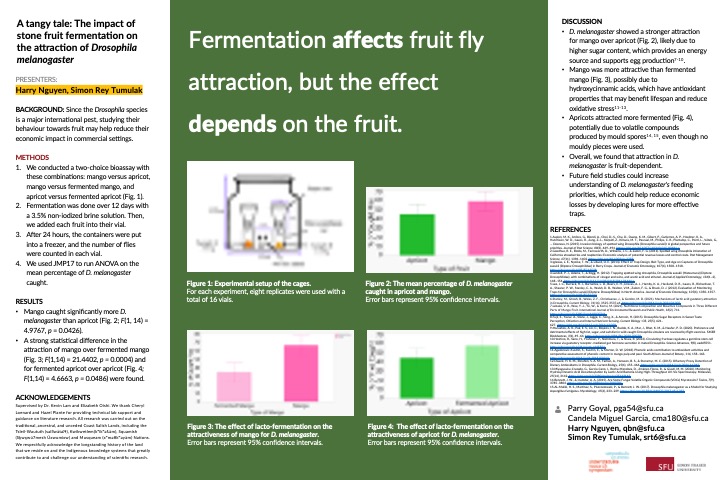
The international trade of infested fruits has caused the rapid spread of Drosophila melanogaster across Europe, Asia, and the Americas, in which Drosophila species have caused $500 million in yearly economic losses in just western North America alone. Typically, Drosophila infest areas high in berry and stone fruit production, where commercial traps often use fermentation products like ethanol, lactic acid, and acetic acid as baits. However, few studies have examined the effects of fermentation on the attraction of D. melanogaster to stone fruits.
In this study, we investigated how lacto-fermentation of stone fruits affects attraction in D. melanogaster through three two-choice bioassay experiments: apricot versus mango, fermented mango versus mango, and fermented apricot versus apricot. We hypothesize that stone fruits that have gone through the process of fermentation will attract more D. melanogaster, due to the new molecular compounds present in them.
The mean percentages of flies caught were analyzed through ANOVA, with all experiments showing statistical significance. Mango attracted more flies than apricot (p = 0.0426), mango attracted more flies than fermented mango (p = 0.0004), and fermented apricot attracted more flies than apricot (p = 0.0486). These results indicate that attractiveness in stone fruits is fruit-dependent, which may be caused by changes in sugar content or variation in fermentation products. Ultimately, our findings suggest that lacto-fermentation can affect preferences in D. melanogaster, and future field studies could further enhance knowledge of their feeding preferences to reduce economic loss.
Article Details

This work is licensed under a Creative Commons Attribution-NonCommercial-NoDerivatives 4.0 International License.