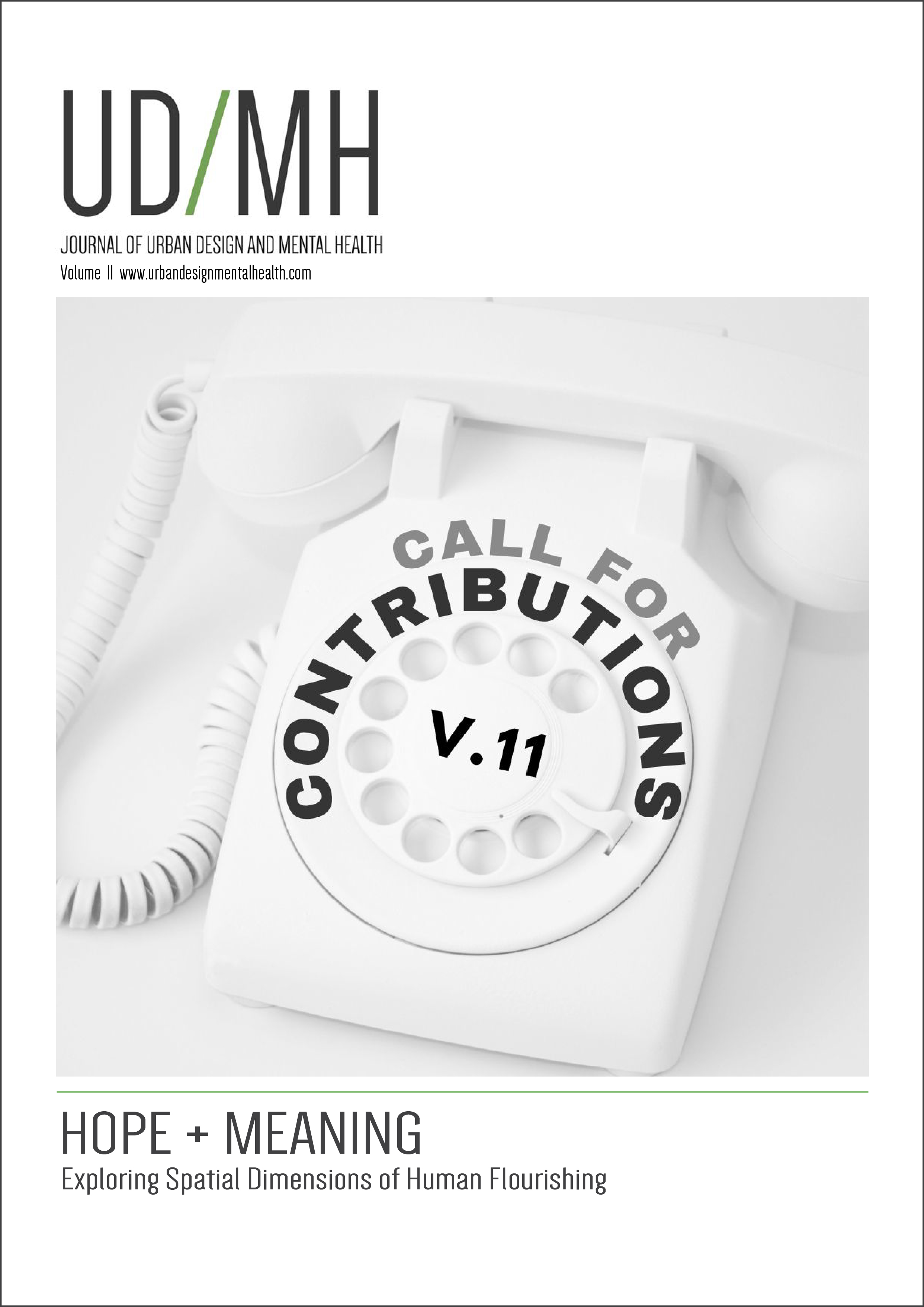
Volume 11 of the Journal of Urban Design and Mental Health proposes to explore the emerging current of design practice and community initiatives that bring a tangible sense of hope and meaning back to people and the planet. Hope, in this context, is understood as a proactive force, a cognitive and emotional scaffolding that enables individuals and communities to envision a better future and take steps toward it, even in the face of uncertainty. We are particularly interested in the urban design of positive transformation: how spaces, policies, and patterns can foster a sense of possibility, agency, and collective engagement.
This call invites perspectives from the full spectrum of human knowledge - from neurourbanism to poetry, from positive psychology to GIS mapping, and from historical precedents to speculative futures. In this volume, we seek submissions that explore rigorous yet imaginative juxtapositions of the arts and sciences with the potential to yield measurable solutions and meaningful insights rooted in positive psychology and in Indigenous wisdom, feminist urbanism, environmental justice, and health economy.
Submit original research articles, theoretical essays, and review papers that explore a wide range of perspectives on the notion of hope and meaning in the urban environment. We welcome submissions that thoughtfully analyse the interplay between empirical evidence, theoretical frameworks, and design implementation in creating and promoting mental well-being in urban settings. Contributions may explore historical theories that have shaped urban design practice, critique current evidence standards, or propose novel theoretical approaches to decision-making in the field. For this volume, we also welcome submissions of art that illustrate the Volume 11 theme. The selected artwork will be featured on the cover. The objective of this call is to bring together scholarly works and practitioners’ perspectives that challenge conventional paradigms and ultimately advance both theoretical discourse and evidence-based practice for healthier urban environments.
Contributions may include any of the following:
- 1,000-2,000 words for case studies and opinion pieces
- 4,000-6,000 words (excluding references) for research articles and reviews.
- Cover Art: Square format, 8 inch x 8 inch or 2400px x 2400px, minimum 300 dpi resolution.
SUBMISSION
Submission deadline: 15 November 2026
Please submit as an MS Word document on our submission site: https://journals.lib.sfu.ca/index.php/urbandesignmentalhealth/about/submissions
Published: 2026-05-12